1, 5, 10 or 20 pallets: which delivery method is cheaper in each case

What determines which delivery method is cheaper
Which delivery method is cheaper — road groupage cargo, a dedicated truck, rail or air freight — depends on more than just the number of pallets. For 1 pallet, speed and the option to consolidate usually matter most; for 5–10 pallets, it's a balance between price and how full the vehicle is; and for 20 pallets, a dedicated truck or a container format may already pay off. Below we break down which factors shape the final bill and why one extra condition can sometimes change the whole calculation.
| Number of pallets | What is usually compared | Key nuance |
|---|---|---|
| 1 | Groupage delivery, courier or express format | Payment for volume, weight and the minimum tariff |
| 5 | Groupage cargo and partial truck loading | The balance between price and lead time matters |
| 10 | Partial load, a dedicated truck or a container | Possible savings per unit of cargo |
| 20 | Full truckload, container or rail transport | Profitability depends on the route and loading |
This material will be useful for importers, manufacturers, distributors and companies that regularly ship cargo to or from Ukraine. For urgent delivery of non-standard or dangerous cargo, however, no universal table can replace an individual calculation: logistics doesn't always get along with simple answers.
Direction, route and type of transport
Cost starts with the route. Distance, border crossings, the availability of regular services, road conditions, ports and terminals all directly affect the tariff. Delivery between major logistics hubs usually offers more options and a lower price than transport to a remote town.
For a small batch, groupage road cargo is often the option considered: several clients share the cost of transport. For 10–20 pallets, a partial or full truckload, rail or container transport may start to make sense. Air freight is almost always more expensive, but it can pay off when every day of delay costs the business more than the tariff itself.
Weight, volume and pallet characteristics
A carrier doesn't simply count "the number of wooden platforms." Length, width, height, actual weight and stackability all matter. Light but bulky cargo may be charged by volumetric weight. Heavy goods, on the other hand, quickly use up the truck's permitted weight capacity.
- a standard pallet size simplifies planning and often reduces costs;
- tall or unstable cargo may need extra space;
- dangerous, temperature-controlled or fragile goods are subject to separate rules and tariffs;
- manual loading, a special forklift or reinforced packaging add to the cost.
Timing, customs, insurance and additional fees
Express delivery costs more than a scheduled one, and a fixed unloading window may involve a surcharge. Customs clearance, brokerage services, documents, terminal storage, access to a restricted zone and vehicle detention are all billed separately.
Insurance shouldn't be forgotten either. Its cost depends on the value and nature of the goods, but potential losses without coverage can be far greater. That's why a correct comparison isn't about finding the lowest tariff, but about weighing the full price: transport, paperwork, additional services, risks and timing. This is exactly why one pallet sometimes costs more per unit than twenty, though a specific route can turn this logic completely on its head.
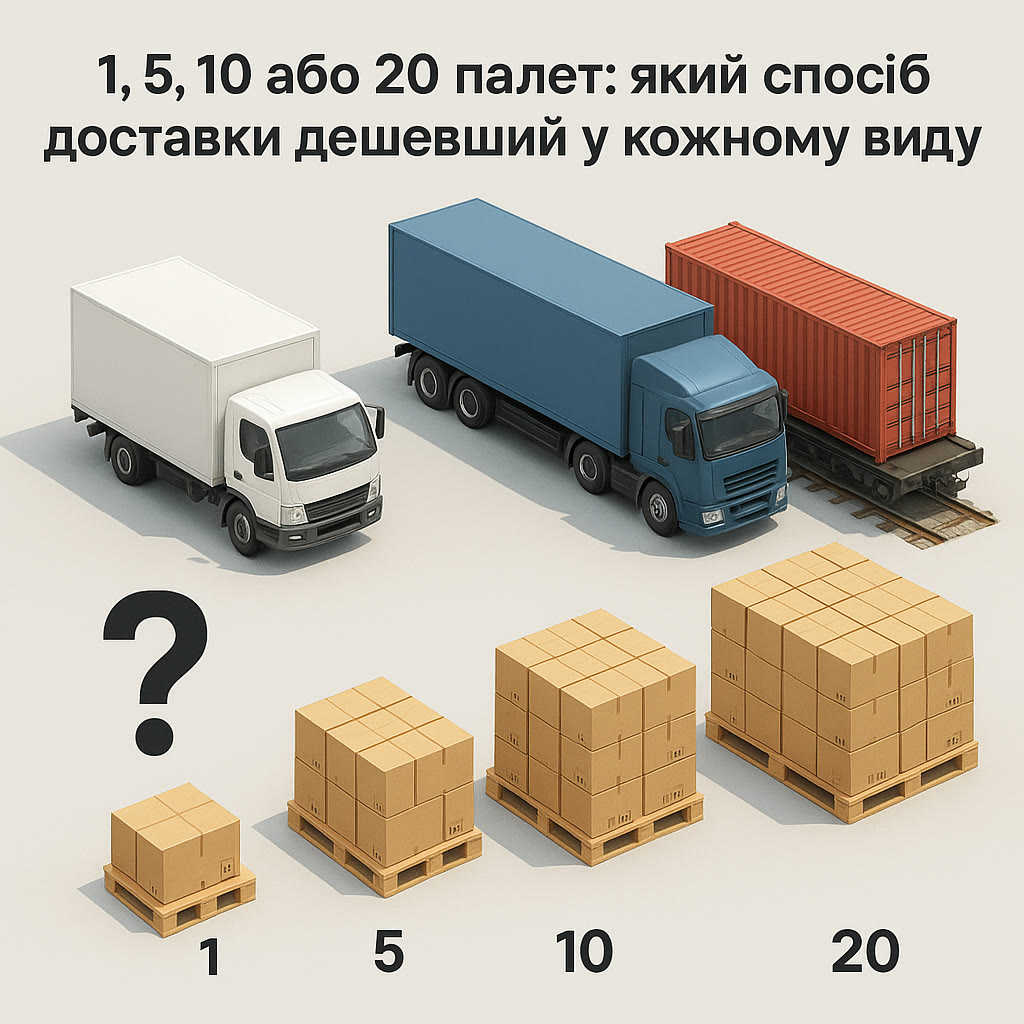
1 pallet: when groupage cargo, courier delivery or air freight pay off
Groupage road cargo: usually the cheapest choice for 1 pallet
For a single pallet that doesn't need to be delivered "yesterday," groupage road transport usually offers the best balance of price and options. The cargo travels together with other clients' shipments, so the customer pays only for the space, weight and related services used, not for the whole truck.
This option is especially suited to planned deliveries between major Ukrainian cities and European logistics hubs. Its advantages are a moderate price, door pickup and a wide choice of regular routes. The drawback is obvious: groupage transport runs on a schedule, and the delivery time can increase because of consolidation, customs clearance and several transshipments.
"The lowest freight price doesn't always mean the lowest costs: a delayed delivery has its own price too."
Before placing an order, it's worth checking whether the tariff includes pickup and delivery to a specific address, loading, unloading, customs support, storage and insurance. Sometimes an attractive base rate no longer looks so attractive once these services are added.
Courier delivery and air freight: more expensive, but sometimes justified
Courier delivery can be convenient for a small, urgent or expensive batch, but a full pallet often exceeds the standard limits of courier services. The shipper may be offered pallet express delivery or asked to split the cargo into several pieces. This simplifies organisation, but the tariff per kilogram or cubic metre is usually higher than in groupage road cargo.
Air freight makes sense when hours or a few days matter more than the minimum price. It could be an urgent replacement for a critical part, medical equipment, product samples, expensive components or a high-margin product. At the same time, for a heavy, bulky or low-value pallet, air delivery is rarely economically rational: the tariff depends on actual or volumetric weight, and additional airport fees increase the total.
Which delivery method is cheaper for a single pallet? In most planned cases — groupage road transport. Courier or air options win not on price, but on speed, predictability and convenience.
A practical selection algorithm for small business
To avoid picking a carrier at random, answer the following questions in order:
- Is the delivery urgent? If not, start by asking for the groupage road cargo tariff.
- What are the exact dimensions, weight and value of the pallet? Without this data, the comparison will only be approximate.
- Is the cargo fragile, dangerous, temperature-sensitive or non-stackable?
- What is the full price including pickup, customs, insurance, door delivery and possible storage?
- What costs the business more: several days of waiting or the express tariff?
After that, it's worth requesting at least two or three quotes in different formats. Compare not the advertised rate, but the final amount, the lead time and the list of included services.

5 pallets: how the price changes and when to book dedicated transport
Groupage transport for 5 pallets: savings through consolidation
Five pallets are an intermediate volume, for which groupage delivery often remains the most cost-effective solution. The cargo takes up only part of the trailer, while route, fuel, driver and border-crossing costs are split among several shippers. So the company pays for the space it actually uses, not for the whole truck.
This format is especially suitable for irregular deliveries, when there's no fixed date for dispatching a large batch. However, the savings depend on the pallet dimensions. Five standard low pallets and five tall, unstable pallets that can't be stacked place a completely different load on the trailer. In the latter case, the carrier may charge not just for floor space, but for extra volume too.
Consolidation also affects timing. If the carrier waits for the truck to fill up, dispatch may not happen right away. For planned goods this is usually an acceptable trade-off, but for an urgent order it's a potential source of losses.
"Five pallets are not yet an automatic reason to book a whole truck: you first need to calculate the space actually occupied."
Partial load or a dedicated truck
Partial loading is an intermediate option between groupage delivery and a full truck. The customer reserves most of the trailer or a specific section, but doesn't necessarily pay for the entire vehicle. This can make sense if the cargo has special requirements: it can't be placed next to other goods, frequent transshipment is undesirable, or a separate temperature regime needs to be guaranteed.
A dedicated truck for five pallets is worth considering when the cargo is bulky, expensive, fragile, or must be picked up and delivered at a precisely defined time. This format can also pay off for a regular route if the company has stable weekly shipments. The carrier can offer a contract rate, and the customer can plan loading without waiting for other batches.
At the same time, the main risk is overpaying for empty space. If five pallets occupy only a third of the trailer, the actual cost per pallet can turn out to be much higher than in the groupage format. Additional costs don't disappear either: the full mileage, detention, toll roads, truck positioning and the return of empty transport all still have to be paid for.
How to determine the most cost-effective option
Which delivery method is cheaper for five pallets can only be determined after comparing full commercial offers. Ask carriers to calculate separately:
- groupage cargo with door delivery;
- a partial load with a guaranteed dispatch date;
- a dedicated truck with a fixed route and timeframe.
In each quote, check whether loading, unloading, customs clearance, insurance, address delivery, storage and possible detention are included. Comparing only the base rate is like choosing lunch by the price of the napkin: the figure looks nice, but it won't fill you up.
If shipments repeat weekly or monthly, it's worth analysing total costs over the period rather than a single trip. Regularity makes it possible to combine batches, agree on a fixed schedule, and gradually switch to dedicated transport only once it's genuinely full.
10 or 20 pallets: groupage cargo, LTL or a full truckload — which is cheaper
10 pallets: when LTL is still cheaper than a full truckload
For ten pallets, the choice is no longer as obvious as for one or two. LTL — less-than-truckload transport, where the cargo shares the trailer with other batches — often remains cheaper. However, the gap with FTL, meaning a full truck dedicated to a single client, can narrow significantly if the pallets are tall, non-stackable or take up a lot of space.
In LTL, payment usually depends on pallet spaces, volume, weight, route and additional operations. The carrier combines cargo from different clients, so trip costs are shared between them. This is advantageous when the shipment isn't urgent and the cargo can be safely transported alongside other goods.
A full truckload for ten pallets can be justified when an exact loading date, delivery without intermediate terminals, or a minimal number of transshipments are required. This is especially important for fragile goods, expensive equipment, short shelf-life products, or cargo that can't be placed next to other goods.
"The closer a partial batch gets to the truck's capacity, the less sense it makes to pay for numerous intermediate operations."
At the same time, there's no universal rule that ten pallets automatically mean FTL. On one route, LTL will have a significant price advantage; on another, the fixed rate for a dedicated truck will be almost the same. What matters isn't only the number of pallet spaces, but also the specific route, schedule and cargo characteristics.
20 pallets: partial transport approaches FTL
A batch of twenty standard pallets is often already close to the capacity of a typical heavy-duty truck, but the exact threshold depends on pallet dimensions, height, weight and stackability. If the cargo actually occupies most of the trailer, the LTL tariff can be close to the cost of a dedicated truck. In this situation, FTL often provides better control and predictability.
| Format | When it can pay off | Main trade-off |
|---|---|---|
| LTL | The batch doesn't fill the trailer and timing is flexible | More transshipments and a less precise lead time |
| FTL | The cargo takes up a significant part of the truck or needs direct delivery | Paying for the entire vehicle |
| Container | Suitable for a sea, rail or multimodal route | Terminals and extra planning are required |
Container and multimodal solutions
Container transport can be worthwhile for international routes, especially when sea, rail and road transport need to be combined. It allows the cargo to move without unloading the container itself when the mode of transport changes, which reduces the risk of damage.
However, the tariff also includes container positioning, terminal fees, document processing, storage, customs procedures and delivery on the first- and last-mile legs. A multimodal scheme isn't always faster than direct road transport, but it can be more economical on long international routes.
Which delivery method is cheaper for 10 or 20 pallets can only be determined after comparing the full cost. Ask for separate quotes for LTL, FTL and a container route, and clarify timing, the number of transshipments, carrier liability and the list of customs documents. The lowest tariff, without accounting for terminals and detention, may turn out to be nothing more than a nice figure in a marketing brochure.

How to calculate the real delivery cost yourself
The full shipping cost formula
To understand which delivery method is cheaper, compare not the advertised per-pallet tariff, but the final amount you'll actually have to pay. The basic formula looks like this:
Full cost = freight tariff + cargo pickup + delivery to the warehouse or door + loading and unloading + customs clearance and payments + storage + insurance + fuel, seasonal and other surcharges.
For international delivery, this amount may also include terminal fees, document charges, brokerage services, vehicle detention, delivery to a remote address, or transport of cargo with special conditions. If some services are already included in the base rate, ask the carrier to confirm this in writing, so the same operation doesn't appear on the invoice twice.
A step-by-step checklist for comparing offers
- Record the exact data: the number of pallets, length, width, height, total weight, value and nature of the cargo.
- Define the route to a specific address, not just to a city or country. A tariff to a terminal and "door" delivery are different services.
- Ask for the base tariff, pickup, truck positioning, loading, unloading and delivery to the final warehouse to be stated separately.
- Clarify customs payments, brokerage support, documents, certification and possible costs during inspection.
- Check the charges for storage, detention, redelivery, address changes and waiting time at the terminal.
- Add the insurance payment, fuel surcharge, seasonal coefficient and currency risks if the tariff is pegged to another currency.
- Compare not only the price, but also the lead time, the number of transshipments, carrier liability and the terms of loss compensation.
"A suspiciously low tariff often means not cheaper delivery, but an incomplete calculation."
A calculation template for different pallet quantities
The following table can be used for a preliminary analysis. It's not worth plugging in the same price per pallet in advance: as the batch grows, the per-unit tariff often changes.
| Batch | What to compare | What to pay attention to |
|---|---|---|
| 1 pallet | Groupage tariff, pickup, minimum rate | Whether additional services exceed the base price |
| 5 pallets | LTL, partial load, dedicated truck | The cost of empty space in a dedicated truck |
| 10 pallets | LTL, FTL, container route | The difference in lead time and number of transshipments |
| 20 pallets | Full truckload, container, multimodal scheme | The fixed transport rate and terminal fees |
Ask for at least two or three detailed quotes in the same format. An offer without a breakdown may look cheaper only because it doesn't account for customs, insurance, fuel or delivery from the terminal. Make the final decision based on the full amount and an acceptable level of risk, not on the biggest number with a minus sign.
Frequently asked questions about choosing a pallet delivery method
Frequently asked questions about choosing a pallet delivery method
Is it always cheaper to transport 20 pallets by dedicated truck?
No, not always. A dedicated truck often becomes economically justified when twenty pallets take up most of the trailer, the cargo can't be stacked, or direct delivery without intermediate terminals is required. If the pallets are low, light, allow shared transport, and timing isn't critical, groupage or a container route can remain cheaper. You need to compare the full price of FTL and LTL, not just the tariff for a single pallet.
When is groupage cargo usually cheaper?
Groupage delivery is most often advantageous for one to five pallets, and also for ten pallets if the cargo doesn't take up a significant part of the truck. Trip costs are split among several clients, so the shipper pays for the space actually used. At the same time, pickup, door delivery, transshipment, storage and customs services can be added to the tariff. That's exactly why you need to compare the final quote.
How do pallet dimensions affect the price?
The carrier takes into account not only the number of pallets, but also their length, width, height, weight and stackability. Two batches of five pallets can have different prices: one compact and suitable for two-tier placement, the other tall, unstable or requiring a separate pallet space. For light but bulky cargo, a calculation based on volumetric weight may be applied.
Can several shipments be combined?
Yes, if they have the same shipper or consignee, are compatible in terms of transport conditions, and are ready for dispatch on close dates. Combining shipments can reduce the cost of pickup, documents and the minimum rate. However, the marking of each batch, the distribution of goods, joint packaging and liability for a possible split of the cargo at the terminal should be agreed in advance.
Which delivery method is cheaper if shipments are regular?
For regular shipments, profitability should be assessed over a month or a quarter. A company can accumulate batches to an optimal volume, book fixed spaces in groupage transport, or negotiate a contract rate for a dedicated truck. Sometimes delivering two larger batches instead of several small ones reduces costs but increases the need for warehouse stock.
Documents and conditions to check
What documents are needed for transporting pallets?
For domestic delivery, you usually need documents for the cargo, a consignment note, an invoice or a delivery note, and the shipper's and consignee's details. For international transport, you may need a commercial invoice, a packing list, certificates of origin, a customs declaration, permits for certain categories of goods, and an international consignment note (CMR). The exact list depends on the country, the type of product and the delivery terms.
What should be checked before payment?
Ask to have the route, the timeframe, the list of included services, insurance terms, liability for damage, possible surcharges and detention payment rules confirmed in writing. This check will help avoid a situation where the cheapest offer suddenly becomes the most expensive one after the cargo arrives.
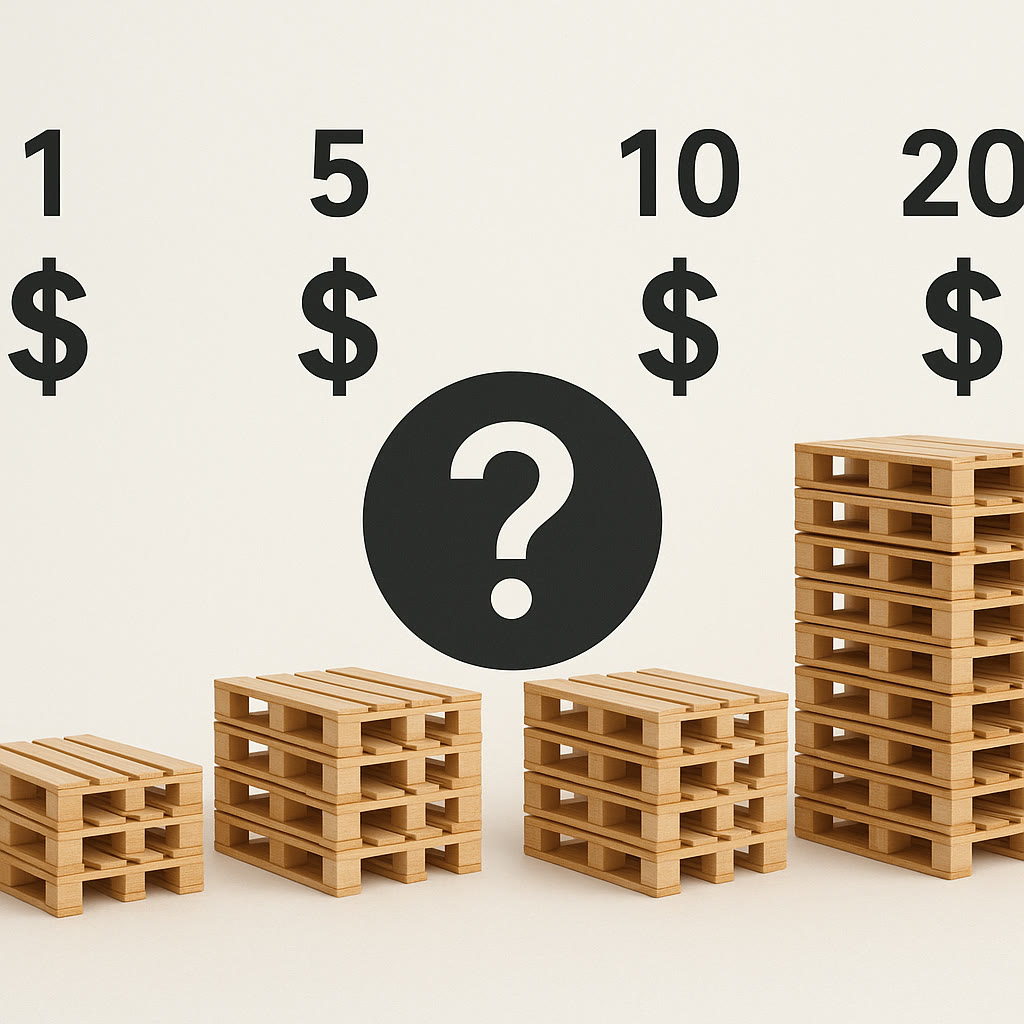
Conclusion: which delivery method is cheaper for 1, 5, 10 and 20 pallets
There's no universal answer to the question of which delivery method is cheaper: what matters is the route, dimensions, weight, timing and the full cost structure. For a single pallet, groupage road delivery is most often the optimal choice. A courier or air format is justified mainly when speed matters more than the minimum price.
For five pallets, it's worth comparing LTL, a partial load and a dedicated truck. Groupage cargo usually wins on price if the timing is flexible and the pallets are standard and suitable for shared transport. Dedicated transport can be cheaper if the cargo is bulky, fragile, expensive or requires an exact delivery date. Regular shipments also make it possible to negotiate better terms.
For 10–20 pallets, partial delivery may already be approaching a full truckload in cost. If the batch takes up a significant part of the trailer, FTL often provides a better price per pallet space, a shorter route and fewer transshipments. On international routes, container or multimodal transport can be an alternative, especially for planned deliveries.
The final choice should be based on the full calculation: add pickup, door delivery, loading, customs clearance, insurance, storage, fuel and seasonal surcharges to the base tariff. The best offer isn't the one with the lowest figure in the ad, but the one where all costs, timelines and carrier liability are clear.

Related posts


Do you have cargo or transport?
Post your offer — and find the right partner today.