T1, NCTS, ENS and ICS2: what carriers now need on the Ukraine — Poland route
What carriers need on the Ukraine — Poland route in 2025–2026
What do carriers need on the Ukraine — Poland route in 2025–2026? For most trips — accurate cargo data, transit processed in the NCTS system, and an advance ENS security declaration through ICS2. But these requirements are not "one package for everyone": T1/NCTS concern customs transit, while ENS and ICS2 concern the security analysis of goods before entry into the EU.
Below is a practical framework for Ukrainian carriers, freight forwarders and companies that organise road transport across the Polish border. It does not replace a check of the specific cargo: additional rules may apply to excise goods, dual-use products, animals, plants or goods subject to permit restrictions.
| System or document | When required | Who is usually responsible |
|---|---|---|
| T1 / NCTS | When cargo is moved under customs transit to the customs office of destination | The declarant, a customs representative, or the carrier by agreement |
| ENS / ICS2 | For the advance submission of security data before entry into the EU | The carrier or another party in the supply chain, depending on the contract |
| Invoice, CMR, packing list | For practically every commercial trip | The consignor, consignee, freight forwarder and carrier, within their own duties |
This material is intended for commercial Ukraine — Poland road transport. It does not cover domestic Polish trips without a border crossing, and it is not a complete guide for dangerous or specially regulated cargo.
What changes for a trip through Poland
Since 2025, road transport to the European Union has needed special attention to ICS2 — the European system for advance cargo information. For road and rail transport, the Release 3 requirements began to be introduced on 1 April 2025, with a transitional period. ENS is submitted before the goods arrive on the customs territory of the EU, and the data is used to assess security risks.
It is important for the carrier to find out in advance exactly who submits the ENS: the carrier itself, the freight forwarder, the importer or a customs representative. Missing or incorrect data can lead to a delay at the border. The exact description of the goods, the number of packages, the weight, the consignor, the consignee, the route and the document numbers are especially critical.
What to check before leaving Ukraine
- whether a transit procedure is required and whether a T1 declaration has been created in NCTS;
- whether the MRN has been obtained and whether the data in the declaration matches the actual cargo;
- whether the ENS has been submitted through ICS2 before crossing the external border of the EU;
- whether the CMR, invoice, packing list, permit documents and seal data are ready;
- whether the duties for submitting information have been agreed between the carrier, the freight forwarder and the customs representative.
The key practical conclusion is simple: T1/NCTS accompanies customs transit, while ENS/ICS2 accompanies the security check before arrival. These are different procedures, and as a general rule one document does not replace the other. An exception appeared on 22 June 2026 together with NCTS Phase 6: via Poland and Slovakia, a transit declaration with security data replaces a separate ENS.
T1 and NCTS: how transit through Ukraine and Poland works
T1 and NCTS are not the same thing
In conversations, carriers often say "process a T1," but technically these are different concepts. T1 is a customs transit procedure for moving non-Union goods through the territory of the European Union without immediate payment of import duties and taxes. NCTS is the electronic system in which transit declarations are processed and tracked under the Convention on a Common Transit Procedure.
Ukraine joined the Convention on a Common Transit Procedure on 1 October 2022. As a result, cargo from Ukraine can travel to the customs office of destination in Poland or another participating country under a single electronic transit declaration. In everyday use, this document is often called a T1, although in NCTS it has its own number — the MRN, i.e. the registration number of the customs document.
"T1 is the customs procedure, and NCTS is the system in which this transit is processed and controlled."
It is important not to confuse transit with import customs clearance. A T1 does not mean that the goods have already been cleared through customs in Poland. It only allows the cargo to be moved under customs control to a designated customs office of destination, where the transit is closed and further formalities are carried out.
When a transit declaration is required and who processes it
A transit declaration is required when cargo is moved under the customs transit procedure, in particular from a Ukrainian customs office of departure to a customs office of destination in the EU. The specific scheme depends on where the customs office of departure, the customs office of destination, the place of unloading and the border crossing point are located.
The declaration is submitted by its owner — the holder of the procedure, a customs representative, or another authorised party. In practice this is often done by a freight forwarder or customs broker, while the carrier passes them accurate data and checks that it has received the MRN and clear instructions on the route.
To understand what carriers need on the Ukraine — Poland route, it is enough to divide the responsibility: the broker prepares and submits the declaration, while the driver must have access to its details and follow the customs route, deadlines and seal requirements.
- the data of the consignor, consignee and holder of the transit procedure;
- an accurate description of the goods, the UKT ZED code or the relevant commodity nomenclature code;
- the number of packages, gross weight, packaging and value;
- the registration numbers of the truck and trailer, the route and the customs offices;
- information about the guarantee and the preceding documents: invoice, CMR, packing list.
Where delays occur in practice
The most common problem is discrepancies between the invoice, the CMR and the NCTS data: a different weight, number of boxes, description of the goods, or trailer number. A trip can also be delayed by a missing guarantee, an incorrectly stated customs office of destination, a seal mismatch, or a procedure not completed at customs.
Before departure, the carrier should check the MRN, the truck and trailer number, the destination point, the seal status and the broker's contacts. If the vehicle changes, this must be reported in good time to the party handling the declaration. One extra phone call before departure is usually cheaper than several hours of waiting at the border — customs bureaucracy has no sense of humour, even when the driver does.
ENS and ICS2: advance declaration of cargo before entry into the EU
What ENS and ICS2 are and why they are needed
ENS is an advance security and safety declaration that is submitted before the goods arrive on the customs territory of the European Union. Its purpose is not customs clearance or tax assessment, but advance risk assessment: the customs authorities need to know in advance what cargo is being moved, from whom, and to where.
ICS2 is the EU information system through which ENS data is submitted and processed. For road transport, the requirements of the third stage of the ICS2 rollout began to apply on 1 April 2025, with an envisaged transitional period. In 2025–2026, a carrier entering Poland from Ukraine should not assume that having a T1 automatically means the ICS2 requirements are met. These are different procedures: NCTS concerns customs transit, while ENS concerns the security of the cargo.
As of 22 June 2026, when Ukraine moved to NCTS Phase 6, an important exception appeared: if the transit declaration is submitted together with the security data, a separate ENS in ICS2 does not need to be submitted when entering the EU via Poland and Slovakia. Via Romania and Hungary, the ENS is still submitted separately.
"ENS does not replace the customs declaration and is not another version of T1: it is advance information for risk analysis before the cargo arrives."
For the Ukraine — Poland route, the declaration is submitted before the truck arrives at the first customs point of entry into the EU. If Poland is the first country of entry, the data must be available to the Polish customs authorities before crossing the external border. An error or missing required information can trigger a request for clarification, a delay, or a ban on further movement until the check is complete.
Who submits the ENS and what data needs to be checked
Responsibility depends on the contractual scheme and the division of roles in the supply chain. The carrier can submit the ENS itself through a suitable solution or ICS2 integration, but in practice this function is often performed by a freight forwarder, customs representative or other authorised party. The importer or consignor must provide accurate commercial data, and the carrier must check the transport part and make sure the submission has actually been made.
Before departure, it is worth agreeing in writing who is responsible for the ENS, who has access to ICS2 messages, and who responds to a customs request. The formula "the broker said he sent everything" is not much help once the cargo is already sitting at the border.
- the full names, addresses and contact details of the consignor and consignee;
- an accurate, clear description of each type of goods, without general wording such as "spare parts" or "consolidated cargo";
- the goods code, if it is required for the relevant data set;
- the number of packages, the type of packaging, gross weight and the identifiers of the container or vehicle;
- the transport document number, the route, the point of first entry, and other details required by the specific procedure.
The invoice, CMR, packing list and ENS data need to be cross-checked especially carefully. The name of the goods, the weight, the number of packages or the consignee's data must not contradict each other.
"The best ENS is the one the driver never has to mention at the border, because all the data already matches."
So, what a carrier needs on the Ukraine — Poland route is: confirmed proof that the ENS has been submitted, the correct submission identifier, agreed contacts for the responsible party, and a set of consistent cargo accompanying data.
A practical checklist of documents and actions before a Ukraine — Poland trip
Checklist before loading and departure
To understand what a carrier needs on the Ukraine — Poland route, it is worth checking not only the folder of documents but also the status of the electronic customs procedures. Every participant in the trip must know their area of responsibility: the consignor prepares the commercial data, the broker processes the declarations, and the carrier cross-checks the information and monitors it while on the move.
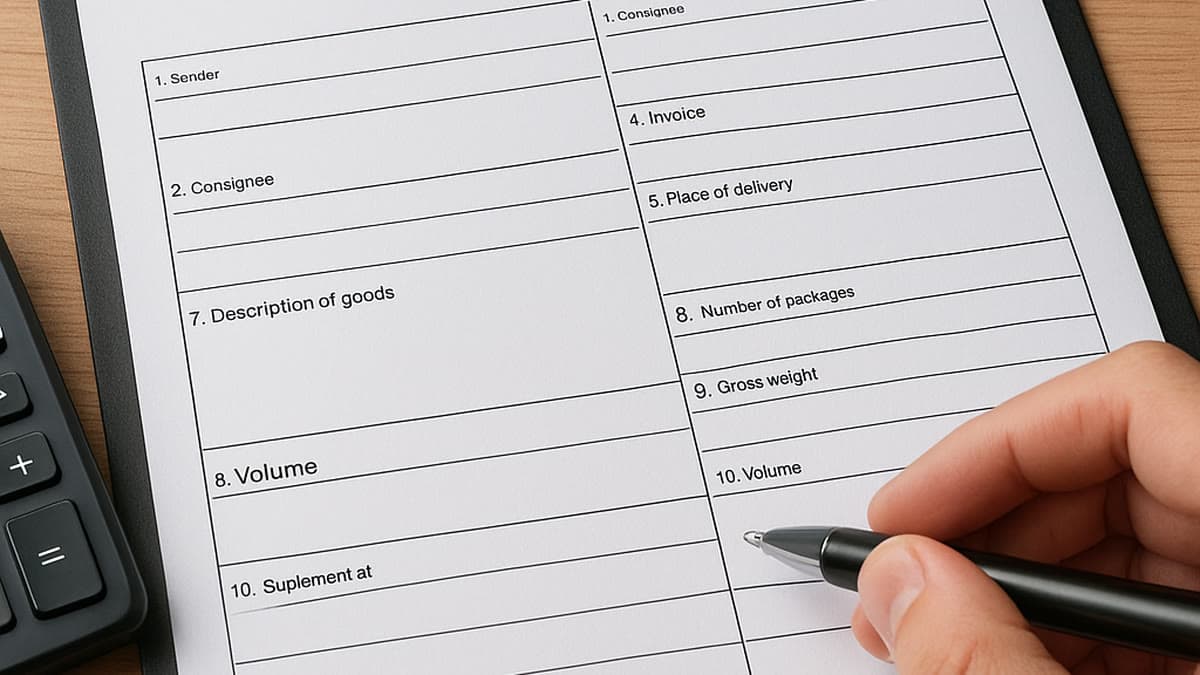
- Cross-check the CMR. Check the names and addresses of the consignor and consignee, the place of loading and unloading, the number of packages, the weight, the description of the cargo, and the truck and trailer number. The data must match the invoice and the packing list.
- Check the invoice. It must include the seller, the buyer, the description of the goods, the quantity, the price, the currency, the delivery terms and the document number. A general description such as "goods" or "spare parts" may not be sufficient for customs control.
- Cross-check the packing list. The number of boxes and pallets, the gross and net weight, and the cargo marking must match the other documents. For consolidated cargo, check the data for each consignment.
- Establish the customs scheme. Clarify whether the cargo is moved under transit, where the customs offices of departure and destination are located, who is the holder of the procedure, and who provides the guarantee.
- Check T1/NCTS. Ask the broker or freight forwarder for the MRN of the transit declaration, check the truck and trailer registration numbers, the route, the customs office of destination and the delivery deadline. If the vehicle or trailer has changed, the declaration data must be updated before departure.
- Confirm ENS/ICS2. Determine who submitted the advance security declaration and obtain confirmation of acceptance or the registration identifier. ENS does not replace T1, and having an MRN does not prove that the ICS2 requirements have been met.
- Keep contacts on hand. The driver must have the phone numbers of the broker, the freight forwarder, the consignor, the consignee and an emergency contact. It is also important to know who responds to customs requests during the trip.
"Before departure, it is necessary to check not only that a document exists, but also that its data matches the actual cargo."
What to keep under control on the road
Paper or electronic copies of the CMR, invoice, packing list, transit declaration and permits must be available to the driver. If the customs broker provides documents through an electronic platform, make sure in advance that the driver has the necessary numbers and can show them without a stable internet connection.
- do not start the trip if the MRN states a different truck or trailer;
- do not accept the cargo without recounting the packages and checking the condition of the packaging;
- do not change the route, the customs office of destination or the seal without agreement from the responsible party;
- if a discrepancy is found, immediately notify the broker and record the problem with a photo or a report.
Right before crossing the border, it is useful to check once more the vehicle number, the MRN, the ENS/ICS2 status, the seal and the customs representative's contact. This short check takes a few minutes but helps avoid detention, resubmitting data, and explanations along the lines of "the document existed, it just wasn't the right one."
FAQ: answers to carriers' questions about T1, NCTS, ENS and ICS2
Are T1 and ENS both needed at the same time?
It depends on the country of entry. As of 22 June 2026, when Ukraine moved to NCTS Phase 6, an important exception appeared: if the transit declaration is submitted together with the security data, a separate ENS in ICS2 does not need to be submitted when entering the EU via Poland and Slovakia. Via Romania and Hungary, the ENS is still submitted separately.
T1 within NCTS is required to move goods under customs transit to the customs office of destination. ENS is an advance security declaration submitted before the cargo arrives on the customs territory of the European Union, through the ICS2 system. They serve different purposes and do not replace each other.
If cargo from Ukraine is heading to Poland under the transit procedure, both a transit declaration with an MRN and an ENS may be required at the same time. At the same time, for individual schemes T1 may not apply, for example when the goods are cleared under a different customs procedure. And the ENS requirements depend on the type of transport, the status of the goods, and the exceptions provided for by legislation. The final scheme should be confirmed with the customs representative before departure.
Who submits the ENS and who is responsible for the data?
The ENS can be submitted by the carrier, the freight forwarder, the customs representative, or another party in the supply chain — depending on the arrangements, the technical scheme, and the role of each participant. The carrier must have a clear answer not only to the question "who submits it," but also to "who corrects an error and responds to a customs request."
The consignor or importer usually provides the commercial details of the goods, while the carrier provides information about the transport, the route and the carriage documents. However, passing on the data does not relieve the parties of the need to check its accuracy. A description of "consolidated cargo" without further detail, an incorrect weight, a different consignee, or a wrong vehicle number can trigger a request and a delay.
That is exactly why the answer to what a carrier needs on the Ukraine — Poland route includes responsibility agreed in writing between the carrier, the freight forwarder, the consignor and the broker. The contract or working correspondence should record who submits the ENS, who processes the NCTS, and who is available outside working hours.
What to do if there is an error in the declaration or the cargo has been detained?
Do not try to "explain away" a discrepancy at the border on your own if it can be corrected through the declarant. First, the problem must be recorded: photograph the document, write down the correct data, notify the broker, and find out whether the declaration can still be amended or whether it needs to be cancelled and resubmitted. Whether a correction is possible depends on the type of declaration and its status in the system.
If the error concerns the vehicle number, the trailer, the seal, the weight or the number of packages, the carrier must immediately notify the party that submitted the document. The seal, the route or the place of unloading must not be changed without agreement from customs or the holder of the procedure. For T1, it is additionally important to follow the customs instructions and deliver the cargo to the designated customs office of destination.
To avoid detention, check the CMR, invoice, packing list, MRN, ENS/ICS2 data and vehicle registration numbers before loading. Ask the broker to confirm the submission status, keep the contacts of the responsible people, and do not set off if obvious discrepancies remain in the documents. A few minutes of checking before the trip usually cost far less than a forced wait at the border.
Conclusion: how to prepare a trip without unnecessary stops at the border
To understand what a carrier needs on the Ukraine — Poland route, two procedures must be kept separate. T1 in the NCTS system provides customs transit to a designated customs office of destination, while ENS through ICS2 conveys advance information for assessing security risks before entry into the EU. Given the appropriate customs scheme, they may be required at the same time. Via Poland and Slovakia, since 22 June 2026 a transit declaration with security data is sufficient, while via Romania and Hungary the ENS is submitted separately.
The consignor or importer is responsible for the accuracy of the commercial information about the goods, the freight forwarder or broker for the agreed processing of declarations and submission of data, and the carrier for reliable transport information, the vehicle matching the documents, keeping the seal intact, and following the customs instructions. Exactly who submits the ENS and who is the holder of the transit procedure must be determined before the trip starts, not at the Polish border.
The practical algorithm is simple: first cross-check the CMR, invoice and packing list; then check the weight, the number of packages, the description of the goods, the codes, the addresses and the vehicle data; after that, obtain the MRN of the transit declaration, check the customs office of destination and the guarantee, and confirm the submission of the ENS/ICS2. The driver must have the documents, the declaration numbers, and the phone numbers of the broker, the freight forwarder, the consignor and the consignee.
If an error is found, the route, the seal or the cargo details must not be changed independently. The declarant or the customs representative must be notified immediately, the possibility of correction must be clarified, and the actual data must be recorded. This kind of check before departure helps avoid re-processing, customs requests, and detention at the border — situations where a few minutes of attention could have saved several hours of waiting.

Related posts


Do you have cargo or transport?
Post your offer — and find the right partner today.