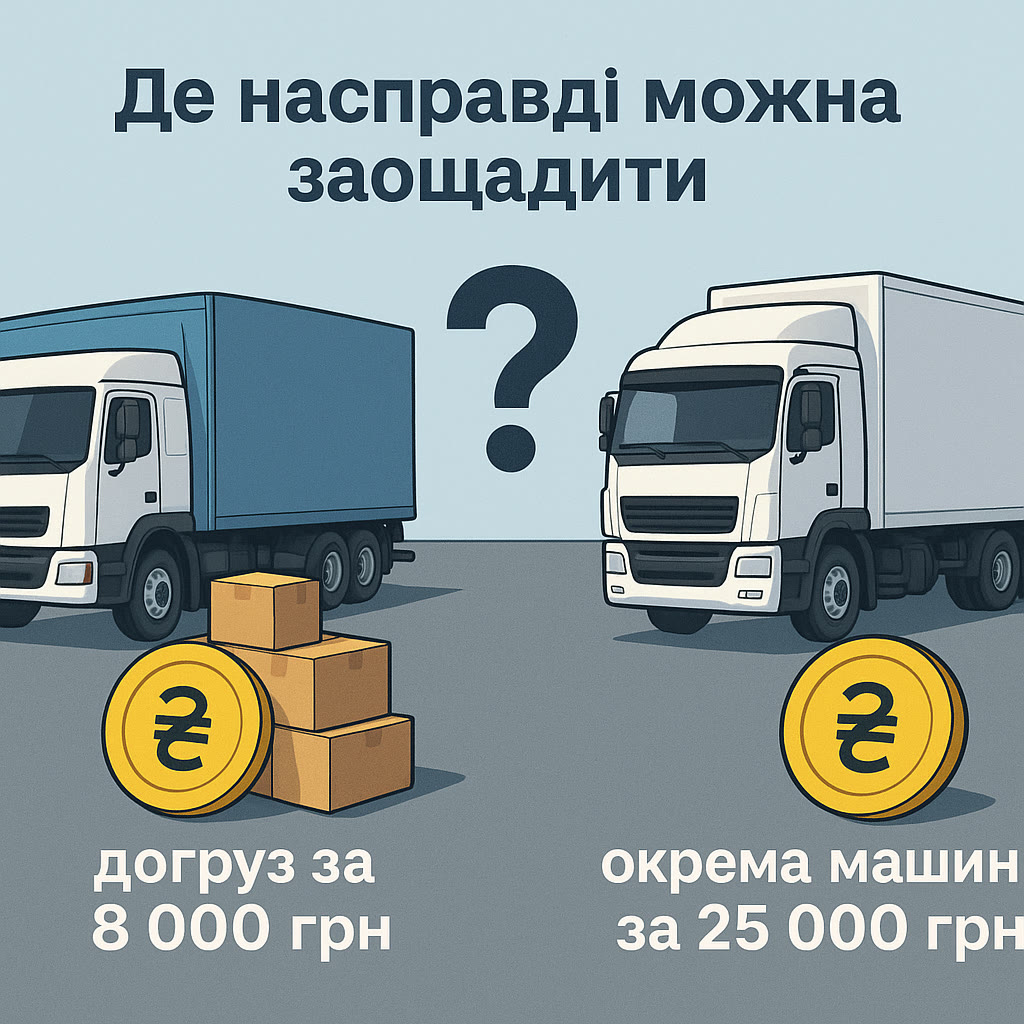
Part load at UAH 8,000 or a dedicated truck at UAH 25,000: where you can really save

Part load at UAH 8,000 and a dedicated truck at UAH 25,000: what's the difference
Short answer: a part load at UAH 8,000 can be more cost-effective for a small batch with no strict requirements on timing or route. A dedicated truck at UAH 25,000 is more expensive but more predictable: the vehicle works solely for your cargo, and the risk of delays and extra transshipment is lower. So where you can actually save on a shipment depends not only on the price in the cargo listing, but also on the shipping conditions.
| Criterion | Part load | Dedicated truck |
|---|---|---|
| Approximate price | About UAH 8,000 | About UAH 25,000 |
| Use of the cargo bed | Shared with other shipments | Fully dedicated to one client |
| Route flexibility | Depends on the main trip | Route and schedule agreed separately |
| Risk of delays | Higher, due to extra stops | Usually lower |
This format suits those who are shipping a small volume, can wait a few days and don't need day-to-day delivery. On the other hand, a part load isn't the best choice for urgent, fragile or high-value shipments, or for cargo that can't be placed next to other goods.
What's included in a part load at UAH 8,000
A part load means using the free space in a truck that is heading out on a given route anyway. The client pays not for the whole vehicle, but for a share of its capacity. That's exactly why the base rate can be three times lower than the rate for dedicated transport.
The price usually includes loading at an agreed time, carriage along the route of the main trip, and unloading at a set point. However, carrying goods up floors, bringing them inside a building, packaging, insurance, detention, extra addresses or delivery outside the route can be charged separately.
- savings on the vehicle's unused capacity;
- possible extra stops and schedule changes;
- limits on dimensions, weight and cargo type;
- an exact delivery window isn't always available.
What a dedicated truck at UAH 25,000 gives you
Dedicated transport is assigned to a single order. The truck travels from the loading point to the consignee without having to adjust to other people's addresses. This reduces the number of transshipments, simplifies control and makes it possible to agree on a specific departure and arrival time.
The rate more often includes bringing the vehicle to the site, the driver's work and carriage of the entire ordered volume. But even here you need to check whether loading operations, waiting time, insurance and toll roads are included. A price of UAH 25,000 isn't automatically "turnkey" — the transport market loves small add-on charges almost as much as a truck loves a smooth road.
Why the cheaper option isn't always the more economical one
If a part load causes production downtime, a disrupted installation schedule or a fine for late delivery, the initial savings of UAH 17,000 can disappear quickly. Before choosing, compare the full cost: the rate, the timeframe, extra services, damage risks and the cost of detention.
So a part load is a solution for planned, small shipments. A dedicated truck is justified when speed, control and a minimum of unpredictable circumstances matter.
When a part load is really more cost-effective
A small shipment with no tight deadline
A part load is most often really more cost-effective when the volume of the shipment doesn't justify paying for the whole truck. If you need to move a few pallets, boxes, furniture or equipment rather than a fully loaded cargo bed, there's no point paying for empty space. In that case, a rate of about UAH 8,000 can be economically justified, whereas a dedicated truck at UAH 25,000 would be paying not only for your cargo but also for unused capacity.
The key condition is the absence of a critical deadline. A part load moves along the route of a vehicle that already has its main load. So the departure date depends on how the trip is put together, and the arrival can be less precise. If the goods aren't needed at the warehouse specifically tomorrow morning, this uncertainty often isn't a problem.
"A part load saves money when time isn't more valuable to the client than the difference in rates."
Above all, this option suits planned deliveries, stock replenishment, seasonal goods, or shipments between branches where there's a buffer of a few days.
Flexible dates and a standard route
The wider your time window, the better the chances of finding free space in a passing vehicle. For example, instead of demanding "pick up by 10:00 on Tuesday," you can agree on a two-to-three-day period. The carrier will be able to find a trip that's already heading to the region you need, and you won't overpay for urgently bringing in dedicated transport.
A part load works best on popular routes between major Ukrainian cities. If the route is typical, without detours to remote villages, complicated addresses or long diversions, finding a passing trip is usually easier. At the same time, it's worth checking whether delivery to your exact town is included, rather than only to the nearest logistics terminal.
Where can you actually save on a shipment? Above all, on paying for the whole vehicle when you only need part of it. But the savings only hold up if the route and the schedule don't create extra costs.
Cargo with no special requirements
A part load is appropriate for sturdy, standard, properly packaged goods that can be placed alongside other shipments. This can include boxes, pallets, building materials, textiles, or oversized but easy-to-secure items.
- the cargo must be packaged and labelled;
- the dimensions and weight must match the data declared;
- the goods must not require a special temperature regime;
- loading and unloading must not require non-standard equipment;
- carriage together with other compatible shipments must be acceptable.
But if temperature control, heightened security, upright carriage, special load securing or a strictly fixed delivery time are needed, a dedicated truck may become the better option.
So a part load is worth choosing for small, planned, standard shipments with flexible dates. In that scenario, the difference between UAH 8,000 and UAH 25,000 stays a real saving, not a risky bet.

Hidden costs: where the savings can disappear
Which extra charges can shrink the difference in rates
A part-load price of UAH 8,000 looks attractive only as long as all the conditions stay standard. In practice, services that weren't factored into the first calculation can be added to the base rate. As a result, the final amount noticeably approaches the cost of a dedicated truck, even though the level of control and delivery speed remain lower.
Loading, unloading, carrying goods up floors, bringing them inside a building, waiting at the address and bringing the vehicle beyond the standard route are most often paid separately. If there's no forklift or freight lift on site, the crew's manual labour can also increase the bill.
| Extra circumstance | How the cost arises | What to clarify in advance |
|---|---|---|
| Waiting time | Payment above the agreed free time | How many minutes are included in the rate |
| Route change | A surcharge for an extra address or kilometres | Whether detours are possible and what they cost |
| Storage | Warehouse fee if delivery is postponed | The daily rate and the terms of free storage |
| A difficult lift | Payment for loaders, floors or special equipment | Exactly what's included in the loading works |
Trans-shipment, detention and paid storage
A part load can involve an intermediate warehouse or transshipment into another vehicle. Every extra operation increases the time on the road and the number of moments when the goods can be damaged, secured incorrectly or mixed up. For sturdy, standard cargo this isn't always critical, but fragile, expensive or complex shipments need more control.
Detention is a separate risk. If the consignee isn't ready to accept the cargo, the driver may have to wait beyond the free limit. With a part load, a delay at one address can affect the whole route, since the truck may be carrying other clients' cargo too. When delivery is pushed to the next day, the need for paid warehouse storage arises.
"A cheap rate stops being cheap the moment all the inconveniences that weren't accounted for at first get added to it."
That's why it's important to record the waiting time, the number of addresses, the storage terms and liability for delay in writing before placing the order. Verbal promises made over the phone don't always help once the bill has already been drawn up.
Insurance and the cost of a possible delay
A carrier's basic liability can be limited, and cargo insurance is sometimes calculated separately. This is especially important for machinery, high-value goods and shipments where a single damaged unit costs more than the entire saving from the part load.
Also assess not only the direct payments, but also the consequences of a delay: idle staff time, a postponed installation, a fine from the buyer, or a halted production line. This is exactly where it's decided where you can actually save on a shipment — on the rate, or on the total cost of the entire shipment.
Before choosing, ask for two final calculations: a part load with possible surcharges, and a dedicated truck with a full list of included services. What needs to be compared isn't the figures "UAH 8,000 versus UAH 25,000," but the final amount, the timeframe and the level of risk.
How to calculate the full cost and understand where you can actually save on a shipment
Start not from the rate, but from the full cost
Comparing a part load at UAH 8,000 and a dedicated truck at UAH 25,000 by the base price alone is a common mistake. A correct calculation should show how much the shipment will cost once all the services, possible delays and risks are added. Otherwise, a low rate can turn out to be just a pleasant figure on the first line of the invoice.
It's convenient to use the following formula:
Full shipment cost = rate + extra services + waiting time and detention + storage + insurance + delay risk.
"Delay risk" doesn't necessarily mean a guaranteed payment. It's the projected cost of possible consequences: paying staff, postponing installation, a fine for being late, or a lost sale. If delivery has no tight deadline, this figure can be zero or minimal. If the goods are needed at the plant on a specific morning, it must be taken into account without fail.
A practical comparison model
First, calculate the base price of each option separately. For a part load, that's UAH 8,000; for dedicated transport, UAH 25,000. Then add the costs that differ depending on the format: loading, unloading, extra addresses, lifting goods, toll roads, waiting time and possible storage.
| Indicator | Question to check |
|---|---|
| Price | Is this the final rate including taxes and vehicle positioning? |
| Volume | Do the weight, pallets and dimensions match the listing? |
| Urgency | What's the maximum acceptable delay? |
| Liability | Who compensates for damage, loss or detention? |
| Extra work | Are loaders, lifting and waiting time included? |
After that, determine the acceptable level of risk. A part load can be cost-effective if the cargo is standard and the delivery date is flexible. A dedicated truck is more often justified when you need to reduce the number of transshipments, get an exact schedule, and pin liability on one carrier.
"Savings are the difference between two final scenarios, not between two advertised rates."
How to decide without complicated calculations
- Choose a part load if the cargo is small, the route is standard, and a delay of one or two days doesn't cause losses.
- Choose a dedicated truck if a specific date, a minimum of transshipments or special delivery conditions matter.
- Ask both carriers for a written estimate listing the included and extra services.
- Compare not only the amount, but also the level of liability and the maximum delivery timeframe.
Where can you actually save on a shipment? Wherever the shipping format matches its value, urgency and requirements. If the full price of a part load after surcharges comes to UAH 11,000 and the delay risk is acceptable, that's a real saving. If detention could cost you UAH 20,000, a dedicated truck at UAH 25,000 may turn out to be the cheaper solution in the end.
Before confirming the order, check three figures: the guaranteed cost, the possible extra payments, and the cost of one day's delay. These are what give you a practical answer — not the mere difference between UAH 8,000 and UAH 25,000.

FAQ: what to choose for a specific shipment
What's the minimum volume suitable for a part load?
There's no fixed universal minimum for a part load. A carrier assesses not only the weight, but also the volume, the number of pallets, the dimensions and the possibility of safely placing the cargo next to other shipments. For one company, a few boxes may be acceptable; for another, only a pallet or part of a pallet.
Before ordering, you need to report the exact dimensions, weight, number of pieces, packaging type and loading conditions. If the actual cargo turns out to be larger than declared, it may not be accepted into the passing vehicle, or the rate may be revised. A part load suits compact, standard, well-packaged shipments that don't need the whole cargo bed best.
How long does delivery take, and who is liable for the cargo?
The timeframe for a part load depends on how the trip is assembled, the route of the main vehicle, and the number of intermediate addresses. So a carrier can name an approximate period but doesn't always guarantee an exact arrival time. If delivery is needed by a specific date, this must be recorded separately in the cargo listing or the contract.
Liability for damage or loss of the cargo lies with the party defined by the contract and the transport documents. It's important to check whether liability covers the entire shipment, what the compensation limits are, and how claims are filed. Upon receipt, it's worth inspecting the packaging, recording any damage in photos, and noting any objections in the report or the consignment note. Signing without reservations can make it harder to prove the problem later.
Carriage usually requires the sender's and consignee's details, a description of the cargo, the number of pieces, weight, dimensions, and the loading and delivery addresses. Depending on the type of goods, a consignment note, an invoice, a handover report or other documents may be needed. The exact list should be agreed before departure, especially if the cargo is commercial or is being transferred between legal entities.
Insurance isn't always automatically included in the rate. You need to clarify whether the carrier's liability applies, what sum the goods are insured for, which risks are covered, and whether there are exceptions. For expensive machinery, fragile products and high-value goods, separate insurance can make more sense than saving on the delivery format.
When is a dedicated truck justified?
Dedicated transport at UAH 25,000 makes sense when you need a specific date, a minimum of transshipments, a direct route or special carriage conditions. It's also a practical option for large volumes, urgent orders, and cargo whose delay would cause downtime, a fine or a disrupted installation.
If the cargo is small, standard, not urgent, and the delivery date is flexible, a part load is usually more rational. But if the risk of delay or damage costs more than the difference in rates, a dedicated truck can be the more cost-effective choice. This is exactly how you work out where you can actually save on a shipment.
Conclusion: a cheaper rate isn't always a cheaper shipment
A part load at UAH 8,000 is cost-effective when the cargo is small, packaged to standard, needs no special conditions, and the delivery date can be flexible. In that case, you pay for only part of the cargo bed rather than the whole vehicle, so the savings can genuinely be substantial.
A dedicated truck at UAH 25,000 is justified for urgent, expensive, fragile or hard-to-transport cargo. Its advantages are an agreed schedule, a direct route, fewer transshipments and clearer carrier liability. If one day's delay means downtime, a fine or a disrupted installation, the difference in rates can turn out to be smaller than the potential losses.
Where can you actually save on a shipment? Not wherever the lowest base price is quoted, but wherever the final amount matches the real shipping conditions. Before ordering, check whether the rate includes bringing the vehicle to the site, loading, unloading, loaders, waiting time, lifting, insurance and delivery to the exact address. Also ask about possible surcharges for a route change, transshipment, detention and storage.
Separately, check the permitted volume and weight, the estimated and guaranteed delivery timeframe, the procedure to follow in case of damage, the liability limit, and the list of documents required. Ask for all agreements to be put in writing rather than left only in a phone conversation.
"A cheaper rate only saves money when it doesn't create more expensive problems."
Compare two full calculations, taking into account the risks, the timeframe and the cost of detention. Then the choice between a part load and a dedicated truck will be financially justified, not just intuitive.


Related posts




Do you have cargo or transport?
Post your offer — and find the right partner today.