Cargo documents in 5 minutes: what a driver must get before departure

Cargo documents: what a driver must receive before departure
You're ready to leave, but the dispatcher is sending documents in pieces: the waybill in a messenger app, a permit by mail, and the cargo data still needs checking. Such haste can turn into a delay at an inspection, a dispute with the client, or problems when the cargo is received. Five minutes before departure is enough to check the basic package and catch critical errors in advance.
Why checking documents matters for the driver
Cargo documents confirm that the driver is transporting a specific product on a lawful basis and along an agreed route. They help establish the sender, the carrier, the consignee, the number of packages, the weight and other characteristics of the cargo.
For the driver, this is primarily protection during an inspection. If the waybill has the wrong vehicle number, delivery address or cargo quantity, time will be lost sorting it out. For the carrier, the documents are proof that the listing was fulfilled, and for the cargo owner, they confirm the handover and the terms of carriage.
It's important that the data in all documents doesn't contradict itself. Discrepancies in weight, product name or the parties' details can cause a delay, a refusal to accept the cargo, or complications with payment for the carriage.
The basic document package before departure
The exact list depends on the type of cargo, the route, the type of carriage and the terms of the contract. Before the trip, the driver must receive or have access to the following documents:
- the consignment note (TTN) — paper or electronic, if issued through the e-TTN system;
- a delivery note, invoice or other document confirming the handover of the goods;
- a cargo listing or carriage contract with addresses, contacts and agreed terms;
- documents for special cargo: certificates, quality certificates, veterinary or phytosanitary documents — when required;
- for an international trip — a CMR and other documents required by customs and transit procedures;
- for dangerous goods — transport documents and permits under ADR requirements.
Separately, the driver must check their own documents and the vehicle's documents: a driving licence of the appropriate category, registration documents, an insurance policy, and any documents required for the specific route.
What to check in five minutes
First, compare the cargo name, number of packages, weight, packaging and marking with the actual load. Then check the sender's and consignee's details, addresses, phone numbers, date, trip number and the vehicle's registration plate.
If the documents are electronic, make sure you have access to the required app or account, and that the file opens without errors. Don't rely only on a photo of the document: where possible, keep the original file or confirmation that it was issued.
Found a discrepancy — don't correct the document yourself. Notify the dispatcher or the sender and ask them to make an official correction before departure. This short check is exactly what reduces the risk of delays and protects everyone involved in the carriage.
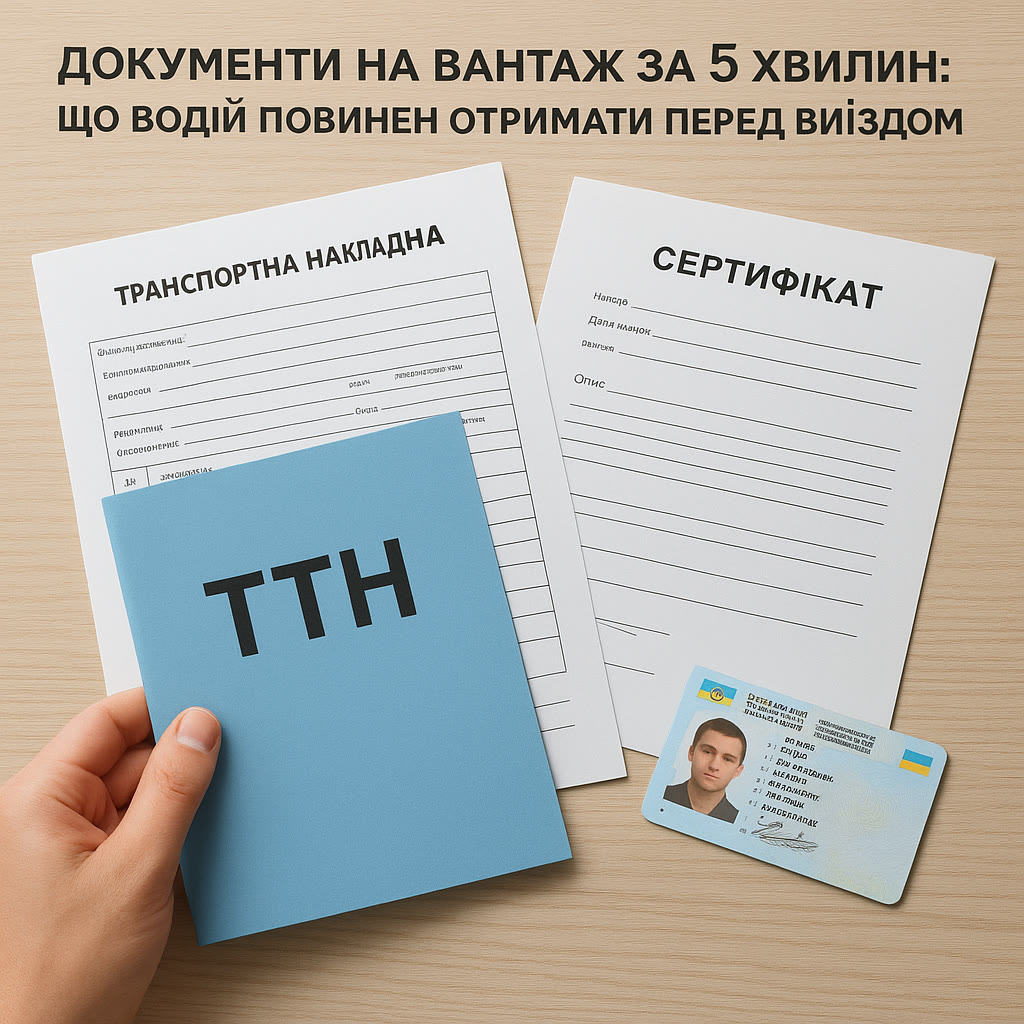
The mandatory document package for domestic carriage
The consignment note: the trip's main document
For most domestic carriage in Ukraine, the key document is the consignment note — the TTN. It confirms the movement of cargo by road and contains the data used to establish who handed over the goods, who is carrying them, and to whom they must be delivered.
Before departure, the driver must check whether the cargo name and quantity, units of measurement, weight, loading and unloading addresses, and the sender's, carrier's and consignee's details are correctly stated. It's also important to check the vehicle, trailer or semi-trailer registration number, the date of issue and the document number.
"An error in a single detail can cause more problems than the absence of a copy of the entire document."
The TTN can be paper-based or electronic, if the carriage is arranged through the e-TTN system. In electronic format, the driver needs access to the document on a device or in the service used by the parties to the carriage. If the system is temporarily unavailable, it's better to agree the procedure with the carrier and the sender in advance.
The delivery note and documents confirming the goods
A delivery note confirms the handover of goods from the seller or supplier to the buyer. It doesn't always replace the TTN, since it serves a different purpose: it describes the commercial transaction involving the goods, not all the circumstances of their road transport.
So before the trip, find out which cargo documents the sender has prepared and which package the consignee requires. Depending on the product, you may need an invoice, a specification, a certificate or declaration of conformity, a quality certificate, or a veterinary or phytosanitary document. Additional requirements may apply to excisable goods and products with a special circulation regime.
- compare the product name in the TTN and the delivery note;
- check the number of packages, weight and marking;
- make sure the documents contain up-to-date details of the parties;
- clarify whether originals, copies or electronic files are required.
The cargo listing and the driver's and vehicle's documents
A cargo listing or carriage contract sets out the practical terms of the trip: the route, the time the vehicle must arrive, the loading address, the contacts of the people responsible, the type of cargo, the rate and the payment procedure. The driver isn't always required to have the full contract on paper, but must receive a clear task and the dispatcher's contacts.
Separately, check the driving licence of the appropriate category, the vehicle and trailer registration certificate, and a valid insurance policy. Certain types of carriage may require additional permits or confirmation of special training.
"Before setting off, the driver needs to understand not only what they're carrying, but also on the basis of which document, and to whom, they are handing over the cargo."
If the data in the documents don't match, don't set off on a guess. Notify the carrier or the sender, record the discrepancy, and ask for the documents to be corrected before the trip begins.

What to check in the documents in 5 minutes
The first minute: who is handing over, who is receiving, and where to go
Start the check with the parties' core details. In the consignment note, the cargo listing and other documents, the names and details of the sender, the carrier and the consignee must match. Check the company code, the address, the responsible person's contact number, and the name of the loading and unloading point.
Pay particular attention to the route. The address in the documents must correspond to the actual place of delivery, not just the name of the settlement. If there are several unloading points, they must be listed separately, stating the order or the volume of goods for each address.
- whether the names and details of all parties to the carriage match;
- whether the loading and delivery addresses are correct;
- whether there are up-to-date phone numbers for the sender, the consignee and the dispatcher;
- whether the route matches the listing and the agreements with the carrier.
Cargo documents must give the driver a clear answer to three questions: who handed over the goods, where they need to be delivered, and who is to receive them.
The second minute: quantity, weight and cargo characteristics
Compare the data in the waybills with what is actually loaded onto the vehicle. Check the total number of packages, the number of pallets, boxes or other packaging, and the gross and net weight, if these figures are stated. Even a discrepancy of a single pallet needs to be clarified before departure.
Separately, review the description of the cargo: name, article number, model, batch, shelf life, packaging type and marking. For food products, chemical products, medicines or goods with special transport conditions, check that the relevant documents and markings are in place.
Pay attention to the transport conditions: temperature regime, body requirements, loading arrangement, restrictions on combined carriage. If the cargo is fragile, dangerous or requires sealing, these features must be clear to the driver and stated in the listing or accompanying documents.
The third minute: signatures, stamps and consistency of documents
Make sure the documents are fully completed: the required dates, numbers, signatures of the responsible persons and, where required by regulations or the company's internal procedure, stamps. At the same time, the absence of a stamp doesn't always make a document invalid, so it shouldn't automatically be demanded in every situation.
Compare the TTN, the delivery note, the listing and other accompanying files. The cargo name, quantity, weight, addresses, trip date and vehicle data must all match. Electronic documents need to be opened on the phone or in the work system, checking that all pages and attachments are accessible.
"A signature on a document matters, but it matters even more that the signed document describes exactly the cargo that is in the vehicle."
Found an error — take a photo or record it in the work chat, notify the dispatcher and ask for the document to be officially corrected. Don't cross out data yourself, and don't set off with unconfirmed discrepancies. The five-minute checklist doesn't replace a full inspection, but it helps quickly filter out the riskiest errors.
Separate documents for dangerous, oversized and international cargo
Dangerous goods: ADR documents and instructions
A standard waybill isn't enough for carrying dangerous goods. The package depends on the hazard class, the UN number, the quantity of the substance, the packaging type and the route. Before departure, the driver must receive a transport document with an exact description of the cargo, its classification, quantity and packaging data.
Written instructions for the crew, documents on the driver's training, a certificate of the vehicle's approval for carrying certain dangerous goods, and confirmation that special equipment is in working order may also be required. The vehicle must carry the relevant hazard signs, plates and equipment required for the specific cargo.
- a transport document with data on the dangerous substance;
- written instructions on actions in the event of an accident;
- documents on the driver's training and the vehicle's approval, if required;
- certificates or quality certificates for the substance;
- confirmation that the packaging is properly marked.
The driver must know not only the name of the cargo, but also the procedure to follow in the event of a leak, packaging damage or a road accident. If the characteristics in the waybill don't match the marking on the packaging, it's dangerous to set off without clarification.
Oversized and overweight cargo
If the dimensions or weight of the road train exceed the established limits, special documents and an agreed traffic procedure are required. The carrier must check in advance whether a movement permit is needed, determine the route, and take into account restrictions on bridges, height, road width and travel time.
Before setting off, the driver must receive the permit document or its electronic confirmation, a route diagram, the movement conditions and instructions for securing the load. The document may state the permitted speed, escort requirements, stopping points and other special conditions.
It's also worth separately checking the actual length, width, height and weight of the road train after loading. Incorrectly stated parameters can make the permit unsuitable for the specific trip.
International carriage: customs and accompanying documents
Crossing a border requires an extended package. It usually includes an international consignment note (CMR), a commercial invoice, a packing list, a customs declaration or the data needed to complete it, and documents on the origin or conformity of the goods, if required by the rules.
Depending on the route and customs regime, a TIR Carnet, a transit declaration, an international carriage permit or special certificates may be used. Additional veterinary, phytosanitary, sanitary or permit requirements apply to food products, plants, animals, medicines and chemical products.
- Compare the name, quantity, weight and value of the goods in the invoice, the CMR and the customs documents.
- Check the countries of departure, destination and transit.
- Make sure the permits are valid on the date of the trip and match the vehicle.
- Keep paper and electronic copies of the documents and the customs broker's contacts.
Cargo documents for an international trip are best checked together with the carrier or a customs broker before loading. The driver shouldn't decide on their own which certificate or permit can be skipped: the requirements depend on the goods, the countries on the route and the customs procedure.

What to do if cargo documents are missing or contain errors
First, stop the processing rather than trying to "sort it out on the way"
If the waybill is missing important data, the document won't open, or the figures don't match the actual cargo, the driver shouldn't set off on a guess. An error in the product name, weight, number of packages, delivery address or the parties' details can cause problems during an inspection and complicate handing the cargo over to the consignee.
Before loading begins, notify the sender that the documents need to be clarified. If a discrepancy is found already during loading, ask for the work to be paused until the circumstances are clarified. Don't confirm with your signature the receipt of goods whose quantity or condition you cannot verify.
The absence of a secondary copy and the absence of the main transport document are different situations. In the first case, it's enough to obtain the file or a paper copy; in the second, further action must be agreed with the carrier and the sender before departure.
Who to notify and exactly what to ask to be corrected
First contact the carrier's dispatcher or responsible manager. At the same time, notify the sender's representative, since they are often the one who issues the TTN, the delivery note and the accompanying documents. Describe the problem specifically: for example, "the TTN states 10 packages, but 12 were actually loaded" or "the delivery address doesn't match the listing."
- record the error in the work chat, an email or another available channel;
- send a photo of the marking, packaging or document if it helps confirm the discrepancy;
- ask for the document to be officially reissued or corrected;
- get the new version and check it before signing;
- clarify whether the previous copy needs to be cancelled or marked as incorrect.
Don't make changes yourself to a document issued by the sender or the carrier. A manual correction without agreement can raise doubts about the document's authenticity. Cargo documents must be agreed between all parties, not merely corrected in the driver's copy.
What to do if the cargo has already been loaded
If the error is discovered after loading, don't sign the document with inaccurate data as confirmation of unconditional agreement. Notify the dispatcher, record the actual number of packages, the condition of the packaging and the presence of seals. Take photos where possible, but don't violate the site's rules or confidentiality requirements.
If the cargo is damaged, has a different quantity, or doesn't match the description, insist on notes being added to the relevant document or on drawing up a report. Don't agree to a verbal promise to "fix everything after delivery" when it's a significant discrepancy.
When the documents can't be corrected, ask the carrier to provide a clear written instruction on further action. Until it's received, it's safer not to leave the loading site or start the trip. This procedure protects the driver from liability for data they didn't draw up and cannot confirm.
FAQ: answers about cargo documents for the driver
Is an electronic TTN on the driver's phone enough?
Yes, an electronic consignment note can be used instead of a paper one if it has been issued in the established manner through the relevant information system and signed by the authorised parties to the carriage. A mere screenshot or photo of a paper waybill isn't always enough: such a file may not confirm the document's authenticity.
Before departure, the driver must check whether the e-TTN opens, whether they're seeing the current version of the document, and whether they'll have access to it during the trip. The phone or tablet should be charged, and where possible, the dispatcher's contact and instructions in case of mobile internet problems should be saved.
If the sender only provides the electronic waybill number, clarify which service to view it in and how receipt of the cargo is confirmed. Cargo documents must be accessible not only to the sender, but also to the driver and other parties to the carriage within their authority.
Who is responsible if documents are missing or contain an error?
Responsibility depends on who issued the document, what obligations are set out in the contract, and exactly what the violation consists of. The sender is usually responsible for the accuracy of the data on the goods, their quantity and characteristics, while the carrier is responsible for organising the carriage and having the documents it must provide under the law or the contract.
The driver isn't necessarily the person who drew up the waybill, but must check the available package before departure and report any inaccuracies. Don't sign a document with data that doesn't match the actual cargo, and don't agree to a verbal correction without confirmation.
If the error can't be fixed right away, record it in work correspondence, notify the dispatcher and ask for a written instruction. This doesn't cancel any possible consequences, but it confirms that the driver reported the problem in a timely manner.
Are copies accepted, and what is checked during an inspection?
A copy may be acceptable if the original or a verifiable electronic document isn't required for the specific document and type of carriage. An ordinary photo without legible details, signatures or access to the original may raise questions. So check with the carrier in advance which format is required for this particular trip.
During an inspection, officials may check the TTN, the vehicle's and driver's documents, and whether the route, weight, number of packages and description of the cargo match. If the actual weight differs from what's stated, don't hide it: ask the sender to issue a clarification or record the discrepancy properly.
"During an inspection, it's not enough just to show the document — you need to confirm that it relates specifically to this cargo, this vehicle and this trip."
If in doubt, calmly explain the circumstances, show the available documents and contact the dispatcher. Don't sign a report or other confirmation without reading its content, and note your own comments if needed.
Conclusion: a short checklist before departure
Before departure, the driver must receive a complete and clear package: the consignment note or electronic TTN, a delivery note or other document for the goods, a cargo listing or carriage contract. The driver's and vehicle's documents are also needed, and for special trips — permits, certificates, customs documents and instructions.
Cargo documents must be consistent with each other. In five minutes, check the sender and consignee, the addresses, the route, the date, the vehicle registration number, the product name, the number of packages, the weight, the packaging and any special carriage conditions. Make sure all electronic files open and that the signatures and required details are present.
If the actual cargo doesn't match the waybill, a document is missing, or the address is wrong, don't sign the papers without comments and don't set off until the circumstances are clarified. Notify the dispatcher and the sender, record the problem, and ask for the document to be corrected or for a written instruction to be provided. Don't make changes yourself.
Once the data has been checked, keep access to the electronic documents, the contacts of the responsible people, and copies of the necessary materials. This short routine protects the driver during an inspection, helps the carrier confirm that the listing was fulfilled, and reduces the risk of delays, disputes and problems during delivery.

Related posts




Do you have cargo or transport?
Post your offer — and find the right partner today.