How Many Pallets Actually Fit in a Truck: 33 EUR Pallets Shown on Diagrams
How Many Pallets Fit in a Truck: The Short Answer
The 11 × 3 Layout: Where the Number 33 Comes From
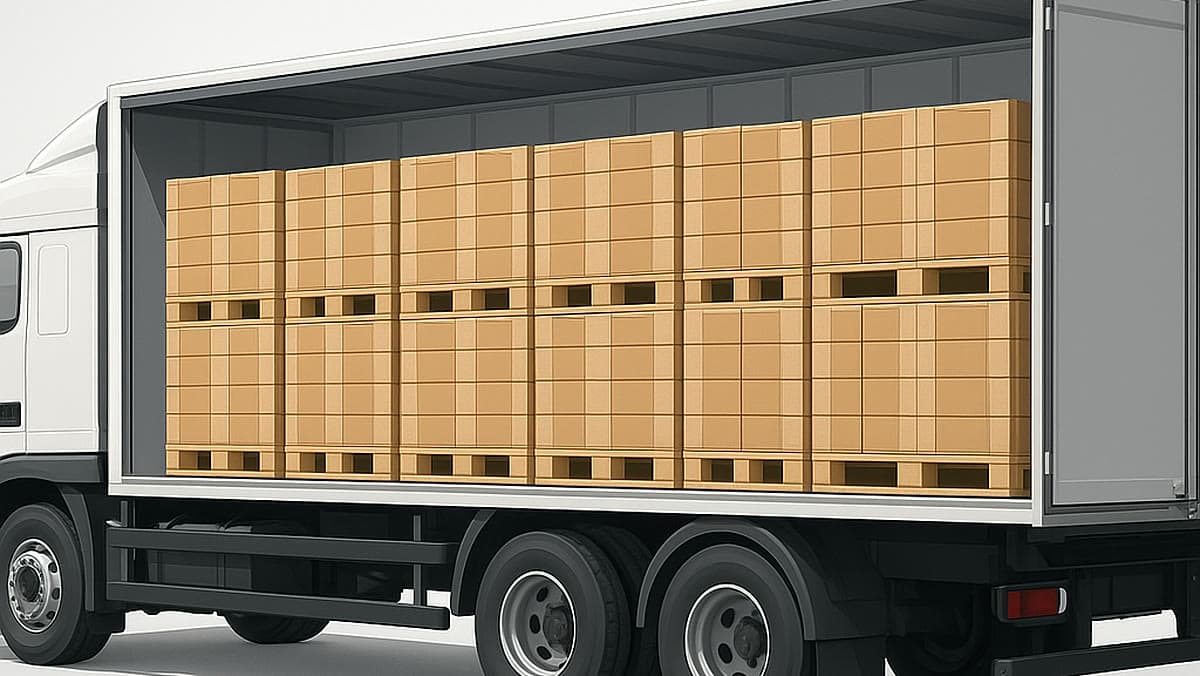
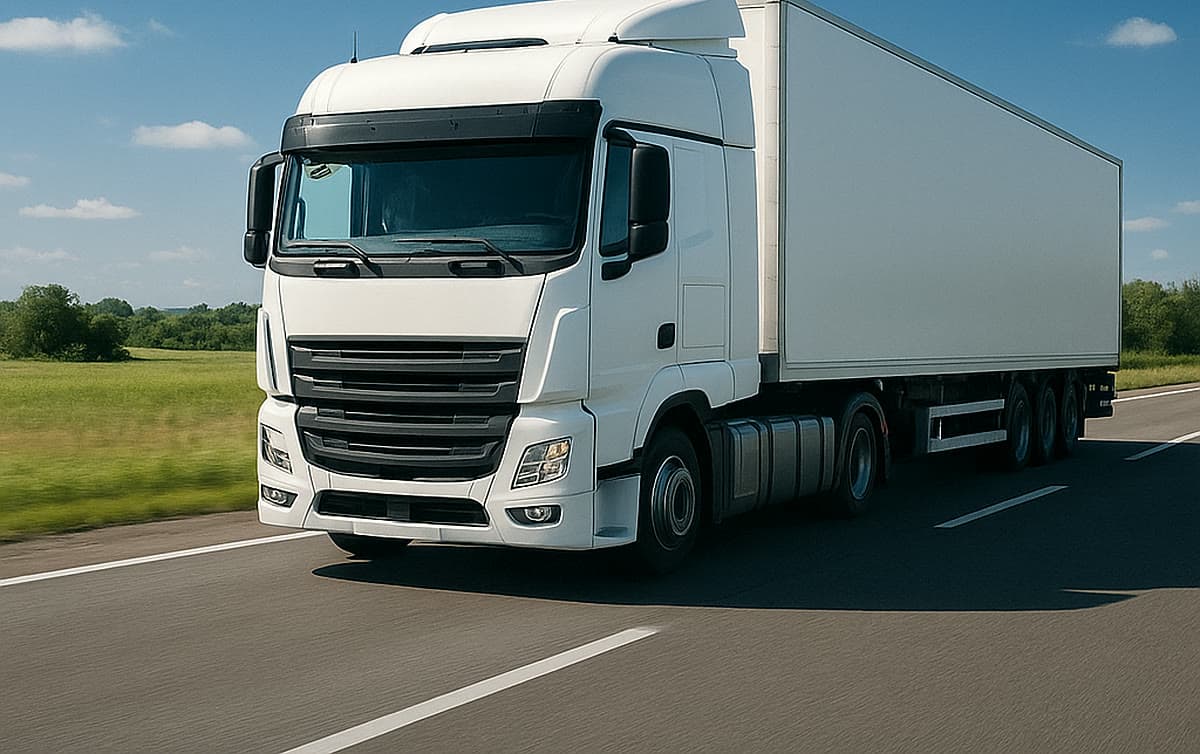
How many pallets fit in a truck? A standard curtain-side euro-truck is usually loaded with 33 EUR pallets measuring 1200 × 800 mm. This is the figure for a single layer, when cargo is placed along the full length of the semi-trailer without exceeding its internal dimensions.
A typical euro-truck has an internal length of around 13.6 m, a width of about 2.45 m, and a height of roughly 2.7 m. With this configuration, 11 rows can be formed along the body, with 3 pallets in each row. The simple formula looks like this: 11 × 3 = 33 EUR pallets.
| Parameter | Approximate value |
|---|---|
| EUR pallet size | 1200 × 800 mm |
| Internal length of the truck | About 13.6 m |
| Internal width | About 2.45 m |
| Standard arrangement | 11 rows of 3 pallets |
| Total capacity | 33 pallets in a single layer |
How Pallets Are Arranged Inside the Body
Three EUR pallets in one transverse row take up 2.4 m of width: 0.8 + 0.8 + 0.8 m. This leaves a small technical clearance for loading, securing the cargo, and compensating for actual dimensional deviations. Eleven such rows require 13.2 m of length, so they usually fit into a standard semi-trailer that is 13.6 m long.
Viewed from above, the floor layout looks like this:
- row 1: 3 pallets;
- row 2: 3 pallets;
- and so on through row 11;
- total: 11 × 3 = 33 pallets.
It's important to note that this applies specifically to standard-size pallets and cargo that doesn't overhang their edges. If boxes, bags, or other goods hang over the edge of a pallet, the actual arrangement can change. The condition of the pallets also matters: damaged or warped pallets take up more space and make secure lashing more difficult.
Why 33 Pallets Isn't Always a Guaranteed Result
Capacity by count is not the same as permitted weight. Even if all 33 spots physically fit in the truck, the total weight of the cargo together with the pallets must not exceed the semi-trailer's payload capacity or the established axle-load limits.
That's why, before dispatch, shippers check not just the answer to how many pallets fit in a truck, but also the weight of each unit, the height of the cargo, how the weight is distributed, and whether it can be securely fastened. For light, uniform goods, the standard benchmark is 33 EUR pallets, but for heavy cargo the limit can be reached sooner.
Truck and EUR Pallet Dimensions: What the Calculation Depends On
Typical Internal Dimensions of a Standard Euro-Truck
To understand how many pallets fit in a truck, you first need to separate a semi-trailer's spec-sheet parameters from its actual usable space. The most common curtain-side truck has an internal length of around 13.6 m, a width of about 2.45 m, and a height of roughly 2.7 m. This is the baseline benchmark for pallet calculations: in September 2026, a curtain-side semi-trailer suits about 73% of cargo listings on SAMO-TRANS, while a truck of 18 t or more is required for 68% of them. For a specific trailer, these figures may differ slightly due to the design of the floor, posts, side rails, wheel arches, and other elements.
It's important to measure dimensions specifically inside the body. The external length of a semi-trailer doesn't show how much space is available for cargo, since part of that space is taken up by the walls, the curtain (tilt) system, the doors, and technical clearances.
| Parameter | Approximate value |
|---|---|
| Internal length of the semi-trailer | About 13.6 m |
| Internal width | About 2.45 m |
| Internal height | About 2.7 m |
| Floor area | About 33 m² (13.6 × 2.45) |
| Payload volume | 82–92 m³ (13.6 × 2.45 × 2.7 ≈ 90 m³) |
| Payload capacity | 20–22 t, with some semi-trailers up to 24 t |
EUR Pallet Parameters and the Basic Loading Layout
A standard EUR pallet measures 1200 × 800 mm. Its area is 0.96 m², but when loading, what matters isn't just the area but also how the pallets fit together side by side. In a 13.6 m long truck, 11 rows of 1.2 m can be placed along the body — a total of 13.2 m. In the transverse direction, three pallets of 0.8 m take up 2.4 m, which usually fits within an internal width of about 2.45 m.
This is how the standard layout is formed: 11 rows × 3 pallets = 33 EUR pallets in a single layer. However, this is a calculation for perfectly matched dimensions, not a guarantee for every kind of cargo.
Geometric capacity shows how many spots can be laid out on the floor, but it doesn't determine whether all of them can be safely loaded.
Why Payload Volume Doesn't Equal the Actual Number of Pallets
The theoretical payload volume of a truck is calculated as the product of length, width, and height: 13.6 × 2.45 × 2.7 m gives about 90 m³, and the typical range for curtain-side semi-trailers is 82–92 m³. But pallets occupy space in blocks, and the cargo on them can have a different shape. Even with sufficient height, it isn't always possible to stack pallets in two layers: the goods may be fragile, unstable, or unsuitable for stacking.
Actual capacity is also affected by:
- boxes or bags overhanging the edge of the pallet;
- uneven or damaged pallets;
- clearances needed for lashing and for opening the doors;
- the shape of the cargo, its packaging, and height restrictions;
- how the weight is distributed between the semi-trailer's axles.
Weight is a separate limiting factor. If the cargo is heavy, the truck may reach its permitted mass before all 33 spots are used. That's why an accurate calculation combines three indicators: dimensions, the number of pallets, and total weight.
33 EUR pallets is a standard benchmark for a euro-truck, not a universal figure for every type of goods.
How 33 EUR Pallets Are Arranged: Loading Diagrams
The Basic Layout: 11 Rows of 3 EUR Pallets
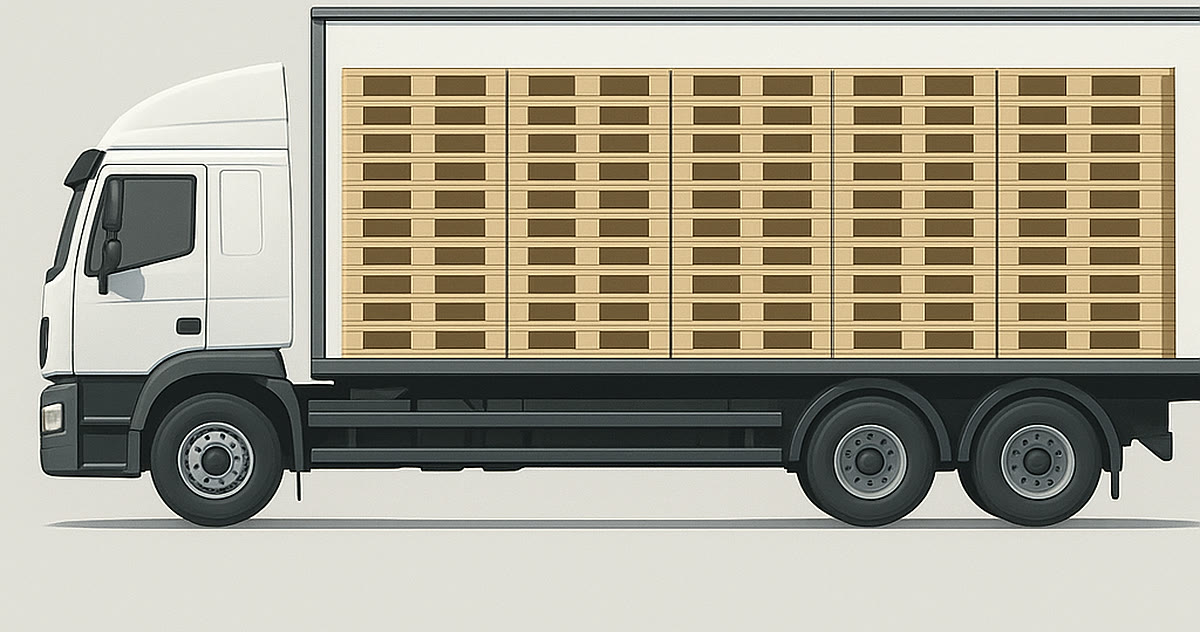
The most common way to load a standard curtain-side euro-truck is 33 EUR pallets in a single layer. They're placed along the body in 11 rows, with 3 pallets set across each row. Given that one EUR pallet measures 1200 × 800 mm, the layout works out as: 11 × 1.2 m = 13.2 m of length and 3 × 0.8 m = 2.4 m of width.
For a truck with internal dimensions of roughly 13.6 × 2.45 m, this layout usually fits. It leaves a small margin in length and width, needed for maneuvering during loading, securing the cargo, and compensating for actual dimensional deviations in the body and the pallets.
| Row | Left position | Center position | Right position |
|---|---|---|---|
| 1 | Pallet | Pallet | Pallet |
| 2 | Pallet | Pallet | Pallet |
| 3–10 | Pallet | Pallet | Pallet |
| 11 | Pallet | Pallet | Pallet |
In shorthand, the layout looks like this: [1][2][3] × 11 rows. So the answer to how many pallets fit in a truck, for the standard EUR layout, is 33 pallets in a single layer.
Accounting for the Doors, Clearances, and the Loading Process
In practice, pallets shouldn't be forced tightly against the doors or walls. Working space near the back of the body is needed for the forklift, and once loading is finished, there must be room to close the doors safely and fit the lashing. The exact margin depends on the semi-trailer's design, the type of doors, and how the cargo is fed in.
It's important that the cargo doesn't extend beyond the pallet's edges. Even a few centimeters of overhanging packaging can prevent fitting three pallets into one row. If boxes are deformed, the wrap film is uneven, or the pallets are oriented differently, additional gaps appear between the rows.
Loading is most often carried out from the front wall toward the doors, distributing the weight evenly along the length. The last row is left for finishing the operation and checking that neighboring pallets haven't shifted. After that, the cargo is secured with straps, bars, or other means if its properties require it.
When the Standard Layout of 33 Pallets Doesn't Work
Sometimes there's geometrically enough free space, but it's not possible to fit all 33 pallets. The reason can be non-standard packaging, increased cargo height, a ban on stacking, or a weight restriction. Heavy pallets are also distributed with axle loads in mind, so part of the space is sometimes left empty.
- Identical light pallets are easiest to arrange in the 11 × 3 layout.
- Cargo with overhangs can reduce capacity to 30–32 spots.
- Heavy goods can limit loading before the entire body is filled.
So the 33-EUR-pallet layout is an accurate baseline benchmark for a standard body, but the final calculation is made using the actual dimensions, weight, and lashing requirements of the specific cargo.
When Fewer Than 33 Pallets Fit in a Truck
Non-Standard Dimensions and Cargo That Overhangs the Pallet
The layout of 11 rows of 3 EUR pallets only works when the cargo matches the dimensions of the standard 1200 × 800 mm pallet. If industrial pallets, pallets of a different format, or units with increased length and width are used, the number of spots in the body can decrease. Even a small difference in dimensions can sometimes prevent fitting three pallets across the truck.
A separate limiting factor is packaging that overhangs the edges of the pallet. Such overhang makes it harder to fit neighboring spots together and can block the forklift's path. If boxes or bags are positioned unevenly, extra gaps have to be left between pallets to avoid damaging the goods during loading and transport.
As a result, instead of the standard 33 spots, a truck may fit only 30–32 pallets or even fewer. The exact number depends not on what the cargo is called, but on its actual length, width, shape, and packaging method.
Height, Weight, and the Impossibility of Stacking
Free space above a pallet doesn't always mean another pallet can be placed on top of it. Two-tier loading requires sturdy packaging, stable goods, and approval from the manufacturer or the carrier. Fragile, liquid, loose, or unstable cargo is often transported in a single layer only, even if the body's height would formally allow more.
Height also matters when placing a single pallet. The cargo must not press against the roof, the curtain, the beams, or other elements of the semi-trailer. A margin is needed to prevent the packaging from being damaged by vibration and the body's movement. If a pallet together with its cargo exceeds the permitted height, it may only be placed in a separate zone, or the type of vehicle may need to be changed.
How many pallets fit in a truck is also a question of weight distribution. Several very heavy pallets can't be uncontrollably concentrated at the back of the body or on one side. The load is distributed along the floor with the permitted axle parameters and the road train's total mass in mind.
- Non-standard pallets can take up more than one calculated position.
- Overhanging cargo requires extra space between rows.
- Fragile or unstable units often can't be placed on top of each other.
- Heavy pallets can reduce the number of spots due to weight restrictions.
- Additional straps, chocks, and anti-slip materials sometimes take up part of the usable space.
Lashing requirements also affect the outcome. If the goods need to be secured with straps, bars, corner protectors, or partitions, access for fitting them must remain between the cargo and the body's structures. So 33 EUR pallets is the baseline capacity of the standard layout, not a guaranteed number for every trip.
What This Means for You: How to Plan a Shipment Correctly
Pallet Slots and Actual Capacity Aren't the Same Thing
When planning a shipment, it's important to understand the difference between pallet slots and the actual amount of cargo. A pallet slot is a notional position on the body's floor, calculated based on the standard pallet size. In a typical euro-truck, there can be 33 such positions, for EUR pallets of 1200 × 800 mm placed in a single layer.
Actual capacity shows how many pallets can be safely loaded, taking into account their weight, height, packaging shape, stackability, and lashing requirements. For example, 33 pallet slots don't mean that the body will necessarily accept 33 pallets of cargo that overhangs the edges or has a non-standard shape.
That's why a cargo listing for a carrier should include not just the phrase "need a truck for 33 pallets," but a full description of the shipment. This reduces the risk of detention, overloading, or having to urgently look for another vehicle. We covered how to describe palletized and groupage shipments in our article on pallets and groupage cargo.
A Sample Calculation for a Shipper or Logistics Manager
Suppose you need to transport 28 EUR pallets of boxes. Each pallet measures 1200 × 800 mm, its height including the cargo is 1.4 m, and its weight is 420 kg. The cargo doesn't overhang the pallets, the pallets aren't stacked, and the total weight of the shipment is 11,760 kg, not including packaging and additional materials.
By floor area, this shipment fits in a standard euro-truck: 28 spots is fewer than the approximate 33 pallet slots. But before booking, you need to check whether the carrier allows this load, how the weight will be distributed along the body's length, and whether straps, chocks, or partitions are needed. If some pallets have a different width or the packaging is deformed, the actual layout may change. An estimated cost for such a trip can be worked out with the logistics calculator, while the final rate is agreed between the shipper and the carrier directly.
As another example, 33 light pallets might take up the entire floor space, while 20 heavy pallets can sometimes already push the vehicle close to its permitted weight limit. So the answer to how many pallets fit in a truck always needs to be supplemented with data on the weight and dimensions of the specific shipment.
| Data | What to check |
|---|---|
| Quantity | Total number of pallets and pallet slots |
| Dimensions | Length, width, and height of each unit |
| Weight | Weight of a single pallet and of the whole shipment |
| Stacking | Whether the pallets can be stacked |
| Lashing | Need for straps, chocks, partitions |
What to Clarify Before Booking a Truck
- the type and internal dimensions of the semi-trailer;
- pallet size: EUR 1200 × 800 mm, FIN (industrial) 1200 × 1000 mm, or non-standard;
- the height of the cargo together with the pallet and packaging;
- the weight of each unit and the total weight of the shipment;
- whether stacking is possible and the permitted load on top;
- the presence of overhangs, fragile elements, or uneven packaging;
- the method of loading, unloading, and the lashing required.
For an accurate calculation, the shipper should send the carrier a diagram or photos of the cargo. This helps distinguish the theoretical 33 pallet slots from the real, safe capacity for that specific trip.
FAQ: How Many Pallets Fit in a Truck
How Many EUR Pallets Does a Standard Curtain-Side Truck Take?
A standard curtain-side euro-truck usually fits 33 EUR pallets measuring 1200 × 800 mm in a single layer. The typical layout is 11 rows of 3 pallets. This calculation applies to a body with an internal length of about 13.6 m and a width of about 2.45 m, provided the cargo doesn't overhang the pallets.
At the same time, 33 is the baseline capacity by floor slots, not a guarantee for every shipment. Non-standard packaging, overhanging boxes, damaged pallets, or the need to leave space for lashing can reduce the number. That's why the answer to how many pallets fit in a truck is always refined using the cargo's actual dimensions and weight.
Does the Capacity of a Reefer, a Mega Trailer, and FIN Pallets Differ?
A reefer is often also designed for 33 EUR pallets, but its internal width and length can be slightly smaller due to the thick insulated walls, refrigeration equipment, and the specifics of the door opening. For a specific semi-trailer, you need to check the spec-sheet internal dimensions: sometimes the actual layout yields 32 pallets or requires a different orientation.
A mega trailer has greater internal height and volume, but its floor area is often close to that of a standard truck. So a single layer usually fits about the same number of EUR pallets — up to 33. The mega trailer's advantage shows up when transporting tall or bulky cargo, not necessarily in a larger number of pallets on the floor.
A FIN pallet (also called an industrial pallet) measures 1200 × 1000 mm, so it takes up more space than a EUR pallet. A typical semi-trailer holds approximately 26 FIN pallets: if the pallets are placed with their long side across the body, 2 pallets fit in a row (2 × 1.2 = 2.4 m), and 13 such rows of 1 m each fit in — a total of 13 × 2 = 26 spots. The exact number depends on the body's dimensions and how the pallets are turned.
| Type of cargo unit | Approximate capacity in a single layer |
|---|---|
| EUR pallet 1200 × 800 mm | Up to 33 |
| FIN pallet 1200 × 1000 mm | About 26 |
| EUR pallets in a reefer | Usually up to 33, after checking dimensions |
How Much Weight Can Be Loaded, and Is a Two-Tier Layout Allowed?
Permitted weight depends on the tractor unit, the semi-trailer, the number of axles, road restrictions, and the rules for a specific route. For common road trains, the payload is 20–22 t, and some semi-trailers can handle up to 24 t, but this is only a benchmark. The permitted gross weight of a road train in Ukraine is 40 t (44 t for combined transport of a container to or from a port or terminal), the load on a single axle is 11 t, on a tandem axle 16 t, and on a tridem axle 22 t — as set out in the rules for the movement of oversize and overweight vehicles (Cabinet of Ministers of Ukraine Resolution of 18 January 2001 No. 30). It's important to account for the weight of the pallets themselves, the packaging, and auxiliary materials, and to distribute the cargo correctly between the axles.
Two-tier transport is only possible for goods that can withstand a load on top, don't deform, and can be securely fastened. Two tiers of 1.3 m each give 2.6 m, which still fits within an internal height of about 2.7 m, whereas two tiers of 1.4 m each already come to 2.8 m — meaning such cargo won't fit under the roof. In theory, 33 pallets could become 66 spots, but in practice, it's not the height that runs out first, but the payload capacity: 66 pallets at even just 350 kg each come to 23.1 t, more than the typical 20–22 t of payload.
Conclusion: 33 EUR Pallets Is the Standard, but Not a Universal Rule
So the standard answer to how many pallets fit in a truck is 33 EUR pallets in a single layer. This is the typical layout for a curtain-side euro-truck: 11 rows of 3 pallets measuring 1200 × 800 mm. With correct placement, this number usually fits within the semi-trailer's internal dimensions.
However, 33 EUR pallet slots is a benchmark, not a universal rule. Actual capacity depends on the body's internal length and width, the size and condition of the pallets, the height of the cargo, the presence of overhanging parts, and the possibility of stacking. For FIN pallets, non-standard pallets, or goods with uneven packaging, the number of spots will be different.
When planning a shipment, you need to separately check the total weight of the batch, the axle loads, and the lashing requirements. Straps, chocks, partitions, and the necessary technical clearances can affect the loading layout. That's why, before booking a truck, it's worth giving the carrier precise data on the quantity, dimensions, weight, and packaging method of the cargo. Only this way can you determine not the theoretical, but the real, safe capacity of a specific semi-trailer.

Related posts

Do you have cargo or transport?
Post your offer — and find the right partner today.