Ukraine has switched to NCTS Phase 6: what changed for international carriers
Ukraine has switched to NCTS Phase 6: what it means
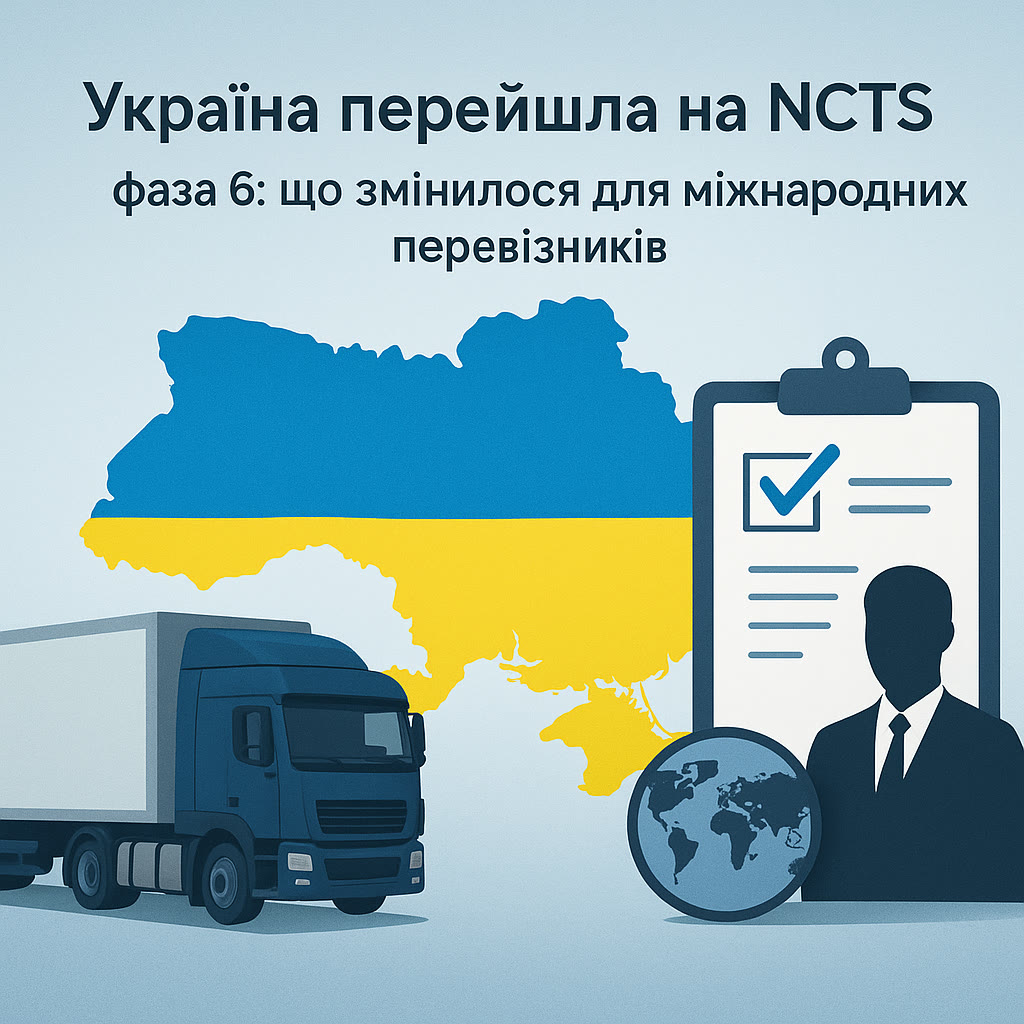
Ukraine switched to NCTS Phase 6 on 22 June 2026. For international carriers, this means an update to the electronic transit system, new data requirements in declarations, and a gradual alignment of Ukrainian customs procedures with European Union standards. Below is a short overview of what exactly changed, who it affects, and whether drivers need to prepare for a "customs revolution" at every checkpoint.
| Question | Short answer |
|---|---|
| What changed? | Ukraine switched to a new technical version of NCTS — Phase 6. |
| Who does this affect? | Carriers, customs brokers, exporters, importers and guarantors of transit operations. |
| Does this abolish paper documents right away? | No. The transition strengthens electronic data exchange, but other documents may still be required. |
This material will be useful for companies transporting cargo between Ukraine, the EU and other common transit countries. It does not replace the instructions of a customs broker or the customs authority's official clarifications for a specific shipment.
What is NCTS Phase 6
NCTS is the computerised system for common transit that allows transit operations to be processed electronically and a single transit declaration to be used along a route through several countries. The system operates under the rules of the Convention on a Common Transit Procedure.
Phase 6 is not a new type of permit for trucks and not a separate customs regime. Above all, it is an update to NCTS's technical and functional platform in line with EU requirements. It introduces a different data structure, more modern electronic messages, clearer division of participants' roles, and better compatibility with the customs systems of partner states.
This matters for a carrier because an error in the data can now affect not only the speed at which the declaration is accepted, but also the ability to correctly carry out the operation at the next stage of the route. As is well known, the customs system has no sense of humour about a stray comma in a document number.
When Ukraine began applying the new stage
Ukraine switched to NCTS Phase 6 on 22 June 2026. The transition was the next stage in the development of the national common transit system after Ukraine joined the Convention on a Common Transit Procedure on 1 October 2022.
The rollout of Phase 6 is part of Ukraine's broader integration into the European customs environment. Ukrainian participants in foreign trade gain the ability to work under rules understood by the customs authorities of EU countries and other common transit participants. At the same time, harmonisation does not mean an automatic end to all checks: customs authorities can still control risky operations, documents and guarantees.
What this means in practice
International carriers should check whether the software and data templates used by the broker or other party filing the transit declaration have been updated. Particular attention should be paid to:
- the accuracy of commodity codes, cargo description and the number of goods items;
- the identification data of the vehicle and the route;
- the guarantee details and the authorised participants in the operation;
- obtaining and keeping the electronic transit operation number.
For a driver, this usually does not mean a new package of paperwork, but the need to have correct information about the declaration and to provide it to customs promptly on request. The more accurate the data at the start, the lower the chance that the cargo will be delayed mid-route due to a technical mismatch.
What changed in the work of international carriers
An updated transit declaration and more precise data
For a carrier, the main change is not a new document to present at every border, but how the transit declaration is generated and transmitted. After Ukraine switched to NCTS Phase 6, participants in the operation work with an updated electronic data structure that is aligned with common transit requirements and the customs IT systems of the participating countries.
The declaration must contain complete and consistent information about the consignor, the consignee, the declarant, the carrier, the vehicle, the route, the place of departure and destination, the goods and the guarantee. The level of detail on the cargo becomes especially important: the description, number of packages, weight, packaging, commodity codes and other mandatory details must match the commercial and transport documents.
In the event of discrepancies, the system may refuse to accept the declaration or require it to be corrected even before movement begins. So "roughly this kind of goods" in the description field is not the best strategy. The customs system does not assess the creativity of wording — it looks for a match in the data.
"The quality of a transit operation begins not at the checkpoint, but with a correctly completed declaration."
Electronic exchange and identification of the operation
In NCTS, participants exchange electronic messages with customs: the declaration is submitted, accepted and, if necessary, corrected, and the status of the operation is tracked in the system. A unique registration number is generated for a specific movement, which customs authorities can use to identify the transit operation at different stages of the route.
This number and the related information must be available to the carrier or driver in a practical form — for example, in documents or electronic materials provided by the declarant. Having the number does not remove the requirement to have other documents for the cargo, if they are needed for transport, control or border crossing.
For a freight forwarder, this means the need to clearly divide responsibility: who files the declaration, who checks the data, who informs the carrier of the operation number, and who responds to a customs request. For a customs representative, it means the need to use up-to-date software and monitor technical notices from customs authorities.
What to check before departure
Before starting a shipment, a carrier should get confirmation from the customer or broker that the transit operation has been created and the data agreed. A practical checklist looks like this:
- check the number of the tractor unit, trailer or semi-trailer;
- make sure the cargo description, number of packages and weight match the documents;
- check the guarantee details and the conditions of its use;
- obtain the transit operation's registration number and pass it on to the driver;
- agree on the course of action in the event of a route change, seal damage, transhipment or other incident.
The updated procedures do not shift all responsibilities onto the driver. However, it is often the driver who is the first to encounter a problem at the border, so they need to understand which operation the cargo belongs to and whom to contact promptly.
How transit through Ukraine now works: a step-by-step algorithm
1. Filing the declaration and preparing the cargo
A typical transit in NCTS begins even before the truck arrives at customs. The declarant or the holder of the common transit procedure generates an electronic transit declaration and sends it to the customs system. It specifies data on the goods, the consignor and consignee, the transport, the route, the customs office of departure and destination, and the guarantee that secures payment of a potential customs debt.
After Ukraine switched to NCTS Phase 6, the compliance of data with the updated electronic requirements became especially important. The cargo description, number of packages, weight, packaging, commodity codes and vehicle registration numbers must match the commercial and transport documents. Because of errors, the declaration can be returned for revision even before the cargo arrives.
Once the declaration is accepted, the system assigns the transit operation a unique registration number. The declarant passes it on to the carrier along with the necessary instructions. The driver needs to know which operation the cargo belongs to and to which customs office it must be delivered.
"You should arrive at customs already with a completed and verified operation, rather than using the checkpoint as a place to look for missing data."
2. Inspection at customs and release into transit
The carrier arrives at the customs office of departure or another designated place and notifies customs of the cargo. To identify the operation, they provide the registration number of the transit declaration, as well as the documents accompanying the shipment. If necessary, customs inspects the goods, the vehicle, the seals and the documents.
Customs assesses risks, checks the guarantee and may set additional control measures. If everything meets the requirements, the goods are released into the common transit procedure. From this moment, the holder of the procedure is responsible for complying with the rules and delivering the cargo to the customs office of destination within the established deadlines.
The carrier's role at this stage is to ensure the actual movement of the cargo along the declared route, preserve the seals and documents, and not change the vehicle or transhipment location without proper notification or authorisation, if one is required. If an accident occurs, a seal is damaged, or another obstacle arises, this should be promptly reported to the responsible persons and to customs.
3. Completing the transit operation
At the customs office of destination, the carrier presents the cargo, the vehicle and the registration number of the transit operation. Customs checks whether the actual data matches the information in the declaration, and whether the customs identification means have been tampered with.
After accepting the cargo, the customs office of destination sends an electronic arrival notification and closes the transit in the system, or initiates further control actions if discrepancies are found. The mere fact that the truck has arrived does not always mean the procedure is automatically completed: confirmation in NCTS is what matters.
After the transit is completed, the customs representative or the holder of the procedure can obtain confirmation for their accounting and guarantee procedures. The practical rule is simple: do not leave the destination point until the responsible party has confirmed that the operation has been properly closed in the system.
"A successful transit ends not when the vehicle arrives, but when the customs system confirms the procedure is complete."
Documents, deadlines and common carrier mistakes
What to check in the documents before departure
After Ukraine switched to NCTS Phase 6, preparing for a trip no longer begins at the border, but during the coordination of data between the consignor, the declarant, the customs representative and the carrier. The driver does not compile the transit declaration themselves, but it is precisely they who must check whether they have received all the information needed to present the cargo.
Before departure, you should make sure you have the transit operation's registration number, the transport and commercial documents, seal data, and instructions regarding the customs office of departure and destination. If permits, certificates or inspection results are required for a specific cargo, they must be prepared separately: NCTS does not replace documents required under other rules.
- check the tractor unit, trailer or semi-trailer number against the declaration data;
- compare the weight, number of packages, packaging and description of the goods with the consignment note;
- check the operation's registration number and the customs office of destination;
- confirm the route and the delivery deadline set by customs;
- write down the contacts of the declarant, the broker and the person responsible for the guarantee.
Separately, you need to check whether the data has changed after loading. Replacing the vehicle, transhipment, adjusting the number of packages, or changing the route may require amendments to the declaration or notification to customs. Driving off on a "we'll sort it out somehow" basis is a method that rarely shortens waiting time.
Deadlines and guarantees: where the risks lie
Customs sets the deadline within which the cargo must arrive at the customs office of destination. It depends on the route, the type of goods, the circumstances of transport and the conditions of the specific operation. It is important for the carrier to factor in this deadline when planning stops, queues, traffic restrictions and possible delays at the border.
The guarantee secures the fulfilment of customs obligations in the transit procedure. Problems arise if the guarantee is invalid, insufficient in amount, does not cover the required operation, or its details were entered incorrectly. In such a case, the declaration may not be released until the discrepancy is resolved.
"Checking the guarantee before arriving at customs usually takes less time than fixing a problem during processing."
Confirmation of the guarantee and its details should be checked by the party responsible for filing the declaration. The carrier should obtain in advance the contact of a person who can promptly correct an error or provide customs with the necessary explanation.
Common mistakes and how to avoid delays
Delays are most often caused by inconsistent spellings of goods names, incorrect codes, wrong weight, a missing trailer in the declaration, errors in document numbers, or a mismatch between the actual seals and the system's data. The risk increases when information is passed verbally through several participants and no one performs a final check.
The optimal course of action is to appoint someone responsible for checking the declaration, cross-check it against the consignment note and packing list, and keep confirmation of the completed operation after release. If an incident occurs en route, you should not change the route or damage a seal on your own without recording the circumstances and notifying the relevant parties.
FAQ: answers to questions about NCTS Phase 6 in Ukraine
Is new registration required to work in NCTS Phase 6?
Does a carrier need to re-register? Usually not. Ukraine's transition to NCTS Phase 6 itself does not mean that every driver or transport company must go through new registration. The transit declaration is still filed, as before, by the declarant, the holder of the procedure, or the customs representative who has the appropriate access to the system.
At the same time, companies should check the technical readiness of their software, electronic keys, accounts and data exchange channels. If a broker files the declarations, it is the broker who must ensure their software is compatible with the new requirements. A carrier does not need to re-register so much as to receive the correct registration number of the transit operation and have access to the documents needed for the movement.
Is a separate permit required for each trip? No, NCTS is not a permit for international transport. The system concerns the customs transit procedure, while transport permits, licences, documents for the goods and driver requirements are governed by separate rules.
Which countries does common transit cover?
Can NCTS be used for a route between Ukraine and the EU? Yes, the common transit procedure is intended for moving goods between countries that are parties to the relevant international convention. It includes the European Union member states and other countries that have joined the common transit area.
The exact composition of participants may change, so before planning a non-standard route, a carrier or broker should check the current list on the official resources of the customs authorities. It is also important to distinguish between the country through which the transit passes and the country where the goods will be imported or exported. NCTS simplifies precisely the transit part of the movement, but it does not remove customs formalities at the point of destination.
Does the system apply to all cargo? No. Whether the procedure can be applied depends on the type of goods, the conditions of movement, the guarantee, and the specific customs regime. Special rules or additional types of control may apply to certain categories.
What to do during a technical failure and who to contact
What should be done if the declaration cannot be sent or the system does not accept the message? First, you should record the error: the time, the operation number, the text of the message, and the stage at which the problem occurred. Then you need to contact the declarant or customs representative who filed the declaration, and the customs office where clearance is to take place. You should not file a duplicate declaration on your own until it is clear whether the previous message has already been registered.
If the failure occurs while en route, the carrier must notify the responsible person and follow customs instructions. If necessary, the customs authority determines the further clearance procedure, including the use of backup procedures or documents. Independently changing the route, removing a seal, or continuing to move without authorisation can create additional risks.
Clarifications on rules and technical issues should be obtained from the State Customs Service of Ukraine, the relevant customs office, a customs broker, or through official software support channels. A reliable source is official customs notices, not a chat with advice like "it used to work this way for us."
Conclusion: how carriers can prepare to work in NCTS Phase 6
Ukraine switched to NCTS Phase 6, so international carriers, freight forwarders and customs representatives need to factor in the updated electronic procedures and data structure. This is not about re-registering every driver, but about a technical update to the system meant to ensure the compatibility of Ukrainian transit with the customs systems of common transit member countries.
In practice, this means: the transit declaration must be filed with accurate data on the cargo, the transport, the route, the customs offices of departure and destination, and the guarantee. The carrier must obtain the operation's registration number, check that the information in the declaration matches the transport documents, and know the course of action in the event of a route change, seal damage or delay.
To reduce the risk of downtime at the border, companies should update their software in advance, agree on responsibility between the broker, the declarant and the carrier, check the guarantee, and carry out a final check of weight, number of packages, the description of goods and vehicle numbers. The delivery deadline set by customs should also be factored into trip planning.
If the system is not working or the declaration contains an error, you should not submit duplicate data or change the route on your own. You need to record the problem, contact the declarant, the customs representative or the relevant customs office, and follow the instructions given. Ultimately, successful work in NCTS Phase 6 depends above all on the accuracy of data, well-prepared information exchange, and clear communication among all parties to the shipment.

Related posts

Do you have cargo or transport?
Post your offer — and find the right partner today.