20 Tonnes Isn't Always a Full Truck: What Actually Limits a Vehicle's Load
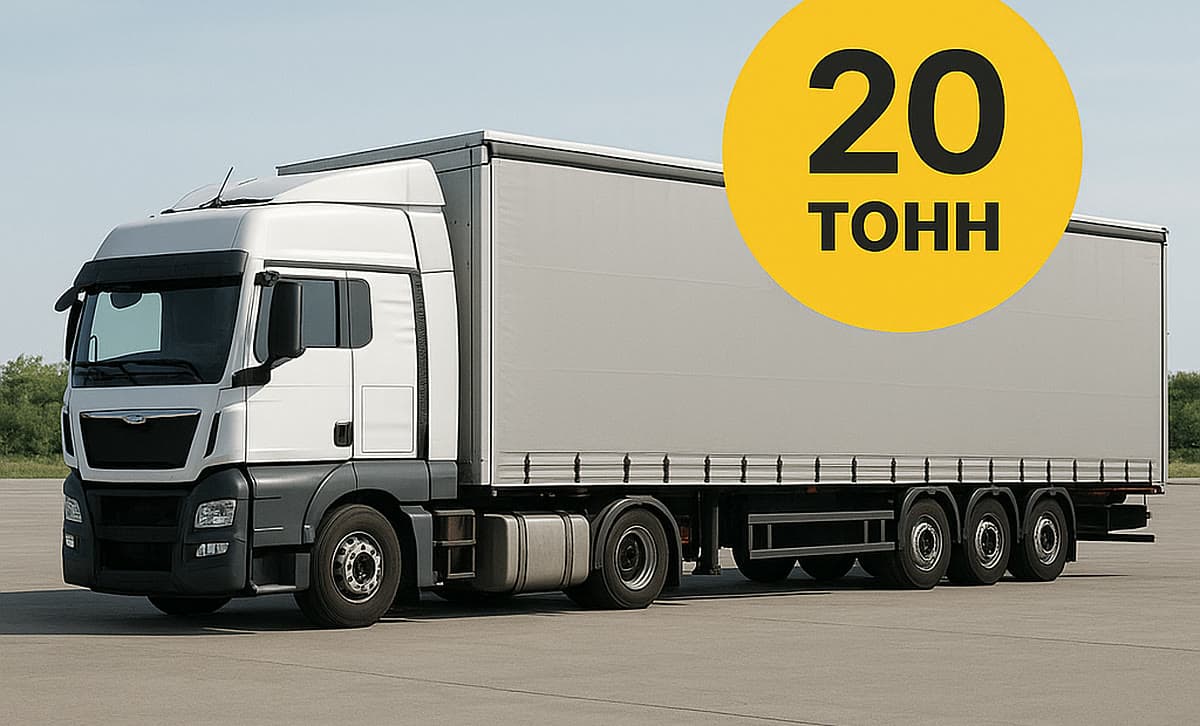
Why 20 Tonnes Isn't a Universal Limit for a Full Truck
Kerb weight, gross weight and payload
In everyday speech, "full truck" is often equated with 20 tonnes of goods. In reality, this is a simplification. For a carrier, a fully loaded road train is a vehicle whose available body volume or permitted payload has been used, without exceeding the set gross weight, axle loads and other regulatory limits.
The key distinction is between three figures:
- Kerb weight — the weight of the tractor unit, semi-trailer, fuel, driver and standard equipment, without cargo.
- Permitted gross weight — the maximum weight of the road train together with cargo, allowed by technical specifications and traffic rules. In Ukraine, the maximum permitted gross weight of a road train is 40 t (44 t for combined transport of a container to or from a port or terminal).
- Payload — the difference between the permitted gross weight and the vehicle's own weight.
So the figure of 20 tonnes usually describes the approximate amount of cargo for a common European curtain-side truck, not a universal standard. At a permitted gross weight of 40 t, the mass available for goods in such a combination is usually 20–22 t, and in individual lightweight versions — up to 24 t. If the road train itself is heavier due to its construction, additional equipment or body type, the mass available for cargo will be lower. Conversely, a lighter vehicle combination may have a greater weight margin — provided this is allowed by the documents and legislation. That's exactly why the rate is calculated for a specific vehicle and trip, not "per tonne": we covered examples of such prices in the article how much it costs to transport 20 tonnes.
What actually determines the available cargo weight
In practice, the answer to the question of what limits a vehicle's load is made up of several factors at once. First of all, these are the technical specifications of the specific tractor unit and semi-trailer: permitted weight, number of axles, suspension type, tyre load capacity and frame strength.
The distribution of goods also matters. Even if the total weight doesn't reach the limit, incorrect placement of pallets can create an overload on one of the axles. For example, an excessively heavy load in the front or rear part of the semi-trailer can formally make the road train unfit to drive, even though the total weight remains within the allowed range.
Road restrictions are taken into account separately. On some routes, seasonal rules, bridge restrictions, temporary signs or special requirements for heavy-vehicle traffic apply. Because of this, a carrier may deliberately load less than the rated payload allows.
Weight, volume and body type: why the result differs
A truck can be limited not by weight, but by volume. Light but bulky cargo — for example, packaging, furniture or insulation — will fill the body before the road train reaches its maximum weight. At the same time, dense cargo, such as metal, tiles or construction mixes, can reach the weight limit before the interior space is fully filled.
The outcome is also affected by the type of semi-trailer, its own weight, height and design features. A reefer is usually heavier than a standard curtain-side semi-trailer because of the refrigeration unit and thermal insulation, so its useful load may be lower — read more about this body type in our overview of reefer transport.
So "20 tonnes" is only a benchmark for a preliminary estimate. The exact figure is determined by the documents of the specific road train, the characteristics of the cargo, its loading scheme and the conditions of the route.
What Limits a Vehicle's Load: Key Factors
Permitted maximum weight: the main, but not the only, limit
The first indicator that determines how much cargo a road train can carry is the permitted maximum weight. This is the total weight of the tractor unit, semi-trailer, driver, fuel, equipment and cargo. Its value is stated in the registration documents and is determined based on the vehicle's design, the number of axles and operating conditions.
If the gross weight of the road train is approaching the set limit, cargo can't be calculated on the principle of "a few more pallets will fit." Even a small excess can become a violation, especially on routes with temporary restrictions or restrictions for individual bridges and road sections.
The permitted weight of a road train is a limit for the entire transport system, not the weight of the goods in the semi-trailer.
That's exactly why the nominal 20 tonnes of cargo doesn't always match the actual capacity of a specific truck. First, the vehicle combination's own weight is subtracted from the maximum permitted weight, and only the remainder can be used for cargo.
Own weight, axles and vehicle design
The kerb weight of the tractor unit and semi-trailer directly reduces the available payload. A heavy tractor unit with a reinforced frame, additional fuel tanks or hydraulic equipment will have a smaller margin than a lighter model. The same applies to semi-trailers: a reefer, tanker, tipper or flatbed can weigh differently due to insulation, refrigeration units, tanks or reinforced construction.
The load on each axle is also monitored separately. The total weight may remain within permitted limits, but incorrect placement of heavy cargo can exceed the limit on a specific axle of the tractor unit or semi-trailer. This affects handling, braking, tyre wear and road surface condition. In Ukraine, 11 t is permitted on a single axle, 16 t on a tandem (dual axle), and 22 t on a tridem (triple axle), and these limits are checked separately from the gross weight.
In practice, what limits a vehicle's load is determined not only by the weights on the scale, but also by the pallet loading scheme. Cargo must be distributed so that the centre of mass remains stable and the axle loads meet technical and regulatory requirements.
- heavy pallets shouldn't be concentrated at one end of the semi-trailer;
- cargo must be securely fastened against shifting during transit;
- the actual weight should ideally be checked before departure, not after passing through weight control.
Requirements of Ukrainian law and roadside checks
In Ukraine, a carrier must comply with the requirements of the Traffic Rules, the vehicle's technical specifications and dimension-and-weight regulations: weight limits are set by the rules for the movement of oversized and overweight vehicles (Cabinet of Ministers of Ukraine Resolution No. 30 of 18 January 2001), and dimensional limits — by clause 22.5 of the Traffic Rules. The basic limits are as follows: the permitted gross weight of a road train is 40 t (44 t for combined transport of a container to or from a port or terminal), width — 2.6 m, height — 4.0 m, the length of an articulated (tractor–semi-trailer) road train — 18.75 m, a road train with a drawbar trailer — 22 m, load on a single axle — 11 t, on a tandem — 16 t, on a tridem — 22 t. Additional restrictions, approvals or special traffic conditions may apply on certain routes. The exact limits depend on the road train's configuration, the number of axles, the road and the road signs in place.
Checks are carried out at fixed and mobile checkpoints, as well as by automatic weigh-in-motion systems. Both the total weight and the load on individual axles can be checked. That's why a safe calculation isn't an attempt to get as close as possible to the conventional figure of 20 tonnes, but a check of all the parameters of a specific trip.
Safe loading starts with documents and calculation, not with free space in the body.
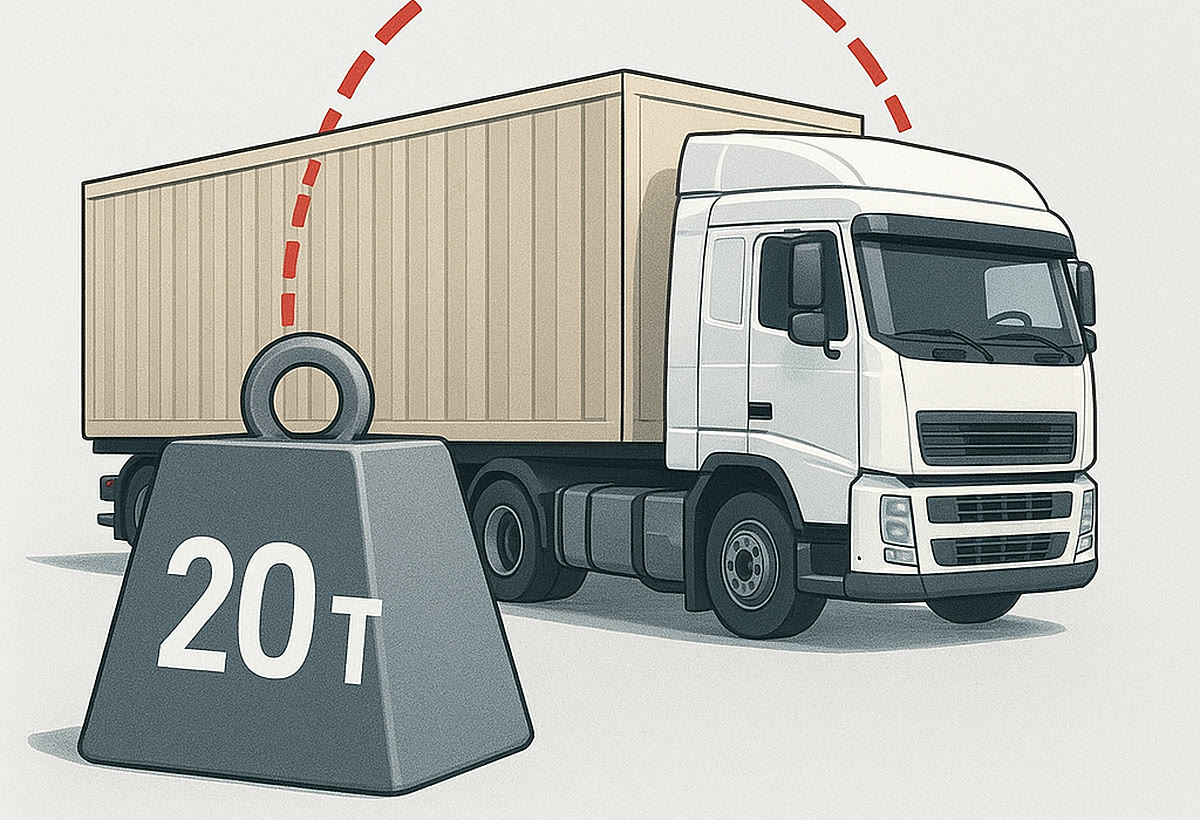
Weight, Volume and Distribution: How the Real Capacity of a Truck Is Determined
Weight and volume: two different limits for one trip
The real capacity of a truck is determined not by a single figure, but by a combination of two parameters: how much the cargo weighs and how much space it takes up. In a standard curtain-side semi-trailer, the internal dimensions are approximately 13.6 × 2.45 × 2.7 m, meaning 82–92 m³ of volume for a payload of 20–22 t. The intersection of these two limits is easy to calculate: 22 t across 90 m³ is about 245 kg/m³. Cargo denser than this threshold runs into the weight limit, lighter cargo — into the volume limit; in logistics, this figure is called volumetric (density) weight. That's exactly why the body can be fully filled even though the road train's permitted weight hasn't yet been reached. This situation is typical for light but bulky goods — packaging, furniture, thermal insulation, plastic products or empty containers.
The reverse case is dense cargo that quickly reaches the weight limit. Metal, tiles, bricks, steel coils or construction mixes may take up only part of the available space but exceed the permitted weight before the semi-trailer is fully filled. Such a vehicle can't be loaded any further, even if there's free space left in the body.
So what limits a vehicle's load — volume or weight — depends primarily on the density of the goods and how they're packaged.
How different types of cargo fill a truck
Palletised cargo is convenient for loading and accounting, but its capacity depends on the pallet dimensions, packaging height and stacking capability. A standard European semi-trailer usually fits up to 33 EUR pallets, but the actual number may be lower due to the weight of the goods, non-standard packaging or fastening requirements. It's simple geometry: a 13.6 × 2.45 m floor gives 33.3 m², and 33 EUR pallets measuring 1.2 × 0.8 m take up 31.7 m² — the rest of the area goes to gaps and fastening. But by weight, at a payload of 20–22 t, each such pallet accounts for only 600–670 kg on average, so heavier goods hit the limit before the floor runs out. We covered how pallet spaces and consolidated shipments are calculated separately: pallets and groupage cargo.
- Light boxes can fill the whole body by volume without reaching the weight limit.
- Rolls of paper, metal or cable have high weight and require precise calculation of the load on the floor and axles.
- Bulk materials — grain, sand, granulate — quickly add up in weight, and their volume depends on bulk density and moisture content.
- Oversized items may not fit by length, width or height even at a low weight. Without a special permit, a loaded road train can't be wider than 2.6 m or taller than 4.0 m — beyond these limits, the trip already needs route approval, as in oversized transport.
The shape of the cargo also matters. Rolls, cylindrical containers and structures with complex contours leave voids between units. Formally, the available body volume is used, but the usable space turns out to be smaller. Oversized items, in turn, may require an open flatbed, special fastenings or separate route approval.
Cargo distribution affects safety and permitted weight
Even a correct total weight doesn't guarantee correct loading. Heavy pallets, rolls or bags need to be placed so as not to create excessive pressure on a single axle. If all the dense cargo is placed closer to the rear of the semi-trailer, the axle load may turn out to be too high, even though the total weight remains within the norm.
When planning, the centre of gravity, floor strength, unloading order and the need for securing are taken into account. Cargo shouldn't shift during braking or when going around bends. So the real capacity of a truck isn't just the number of free cubic metres, but the safe weight, volume and correct placement of goods all at once.
How to Calculate the Load Correctly Before a Trip
Start with the exact weight of the cargo and the vehicle combination
Calculating the load before a trip should start not from the conventional figure of "20 tonnes," but from the actual data on the specific vehicle and goods. First, check the permitted gross weight of the tractor unit with the semi-trailer, the payload of the trailer and the limits for each axle. These parameters are stated in the registration documents and technical documentation.
Next, determine the weight of all the cargo together with packaging, pallets, strapping, fastenings and additional packaging. If the goods consist of several batches, it's not worth relying only on the data in the order: the weight of individual pallets or pieces should ideally be checked on certified scales. An error of a few dozen kilograms can matter when the road train is operating close to the limit.
The calculation should also include fuel, spare wheels, tools, refrigeration or hydraulic equipment and other elements that affect the kerb weight. It's precisely the combination of these figures that explains what limits a vehicle's load on a specific trip.
Check the axle loads and the loading scheme
After determining the total weight, a cargo placement scheme needs to be worked out. Heavy pallets, rolls, metal products or big bags can't be placed arbitrarily. They're distributed along the platform so that the load falls on the zones provided for by the design, and the centre of gravity remains as stable as possible.
The total weight of the road train may be permitted, but a specific axle may be overloaded. That's why, before departure, it's advisable to use scales that show not just the total weight, but also the load on the axles. If this isn't possible, the calculation is done using the vehicle's technical layout, taking into account the distance between axles, the placement of cargo and the kerb weight of the tractor unit and semi-trailer.
- weigh each batch and account for the weight of the packaging;
- check the total weight of the road train and the load on the axles;
- place heavy cargo evenly and secure it reliably;
- make sure the goods don't exceed the permitted floor load;
- reweigh the vehicle after loading, if possible.
Check the dimensions and prepare the documents
Besides weight, the length, width and height of the loaded road train are checked. Cargo mustn't protrude beyond the permitted limits without appropriate marking, and oversized transport may require special route approval, a permit and an escort. Height should be assessed together with the height of the semi-trailer, especially when transporting equipment or tall pallets.
Before departure, prepare the consignment note, invoice or bill, packing list, and data on the number of pieces and weight. For an international trip, documents required by the terms of carriage and customs procedures are usually needed. If the cargo has special properties, requirements for its marking, fastening and transport are additionally checked.
This algorithm makes it possible to spot a problem back at the warehouse, rather than during weight control on the road. It also helps avoid downtime, cargo redistribution en route and risks associated with overloading.
FAQ: Answers to Common Questions About Loading a Truck
How many tonnes does a standard road train usually carry?
In everyday usage, a standard truck most often means a tractor unit with a curtain-side semi-trailer. Such a road train often carries 20–22 tonnes of cargo (individual lightweight combinations — up to 24 t), but this is only a benchmark, not a guaranteed capacity. The actual payload depends on the kerb weight of the tractor unit and semi-trailer, the number of axles, technical condition, body type and the restrictions on a specific route.
A light curtain-side semi-trailer may leave a larger margin for cargo, while a reefer, tanker or reinforced flatbed weigh more. Because of this, the available cargo weight will be lower. In addition, light but bulky cargo can fill the body before the road train reaches the weight limit. So it's more accurate to clarify not "how many tonnes in a truck," but what parameters a specific vehicle has. Based on cargo listings on SAMO-TRANS in September 2026 (1–17.09), a curtain-side body was accepted in approximately 73% of cases, and a full truck from 18 t was searched for in ≈68%: "a 20-tonne truck" remains the most common market request, even though on paper every such vehicle is different.
What happens for overloading, and who's responsible?
Exceeding the permitted gross weight or the load on a specific axle can lead to the vehicle being stopped, a control weigh-in, a requirement to redistribute or unload part of the cargo, and the application of liability provided for by law. In the event of significant overloading, additional costs may arise due to downtime, re-issuing of documents or delivery delays.
The danger isn't just fines. Excess weight worsens braking, increases the load on the tyres, suspension and braking system, and accelerates the wear of the road surface. Incorrect distribution of cargo can make even a road train whose total weight formally doesn't exceed the permitted figure dangerous.
Liability is determined taking into account the specific circumstances and the roles of the parties. The carrier and driver are responsible for the technical soundness of the vehicle, compliance with the driving regime, checking the parameters and safe transport. The shipper, in turn, must correctly report the weight and characteristics of the goods, and comply with the agreed loading procedure. The division of responsibilities can be detailed in the contract, but it doesn't cancel the requirements of the law.
Is it enough to rely on the carrier's data?
Information from the carrier about the available "20 tonnes" is useful for preliminary planning, but it isn't enough for a final decision. You need to check the documents of the specific tractor unit and semi-trailer, the weight of the packaging and equipment, the dimensions of the cargo, its distribution in the body and route restrictions.
It's precisely the combination of these factors that determines what limits a vehicle's load. Before departure, it's advisable to weigh the loaded road train and, if possible, get data separately by axle. This is more reliable than relying on a verbal estimate or a standard figure in a commercial offer.
Conclusion: A Full Truck Is a Balance of Weight, Volume and Safety
A "full truck" isn't automatically 20 tonnes of cargo. The figure can only be a benchmark for a standard road train, while the actual capacity depends on the kerb weight of the tractor unit and semi-trailer, their design, the number of axles, body type and technical specifications. A reefer, tanker or reinforced flatbed often leave a smaller payload margin than a regular curtain-side semi-trailer.
It's important to consider not just the total weight, but also the volume of the cargo, its density and distribution in the body. Light boxes can fill the entire space without reaching the weight limit, while metal, rolls or bulk materials quickly create an overload. Incorrect placement of goods can cause the load on a specific axle to be exceeded even at a permitted total weight.
So what limits a vehicle's load is a combination of technical, legal and logistical factors. Before a trip, you need to check the vehicle's documents, weigh the cargo together with packaging and equipment, assess the axle loads, dimensions and route conditions. The most reliable approach is to focus not on a universal 20 tonnes, but on the actual parameters of a specific road train and a safe loading scheme.

Related posts



Do you have cargo or transport?
Post your offer — and find the right partner today.