Curtain-Side Truck, Reefer or Van: Which Vehicle Fits 10 Popular Cargo Types
How to choose transport for a shipment: key criteria
Weight, volume and how the cargo is loaded
The first step is to determine not just the mass but the overall volume of the cargo. Two shipments of equal weight can need very different vehicles: compact metal parts take up little space, while furniture, cardboard boxes or insulation material fill the body quickly. It's also important to factor in the number of pallets, the stacking height and the permitted axle load.
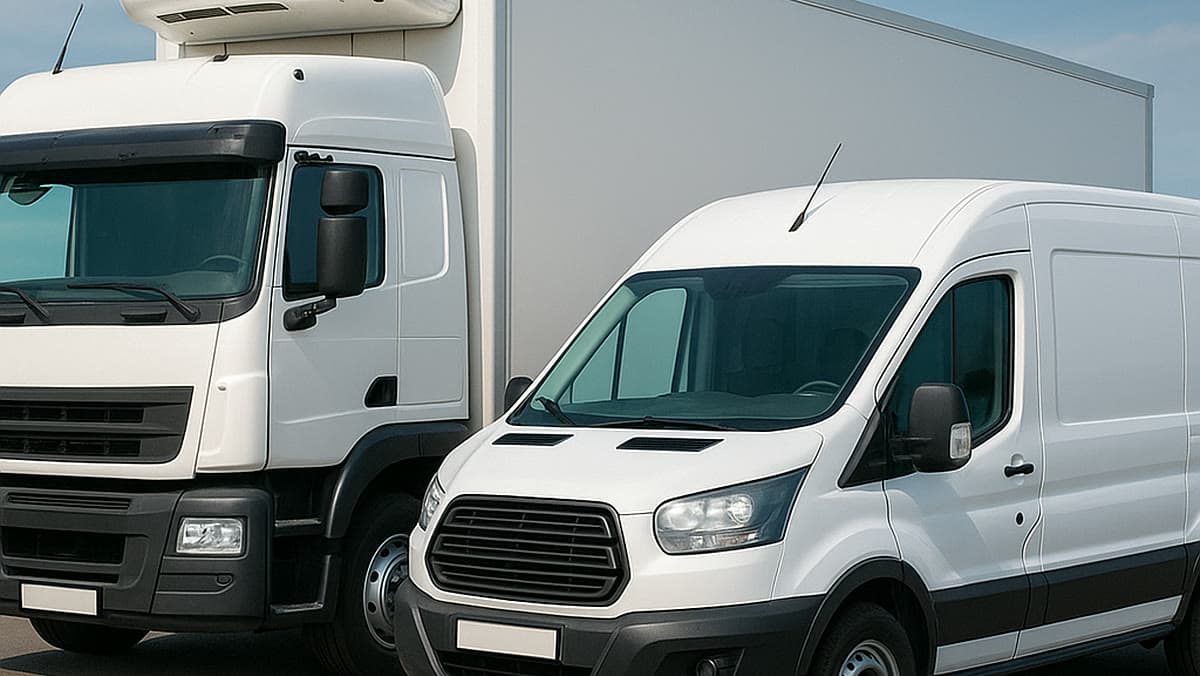
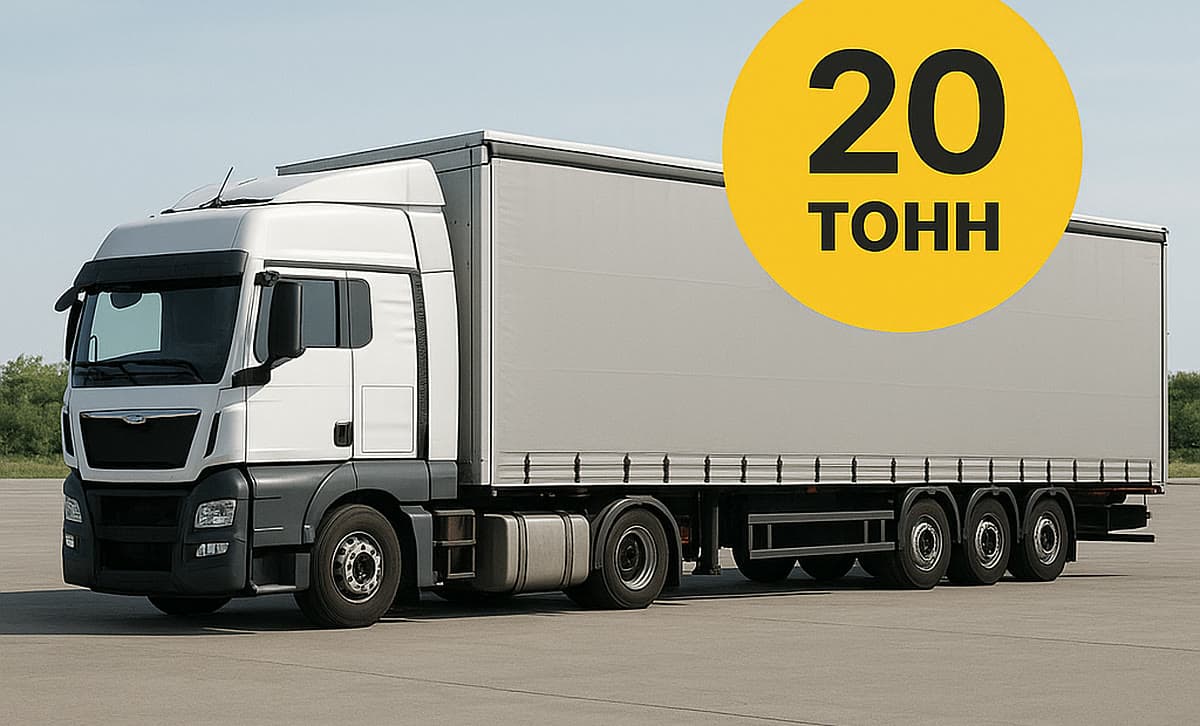
For a small batch, an urgent delivery, or a pickup from a yard or a narrow city street, a van is usually the right choice: it carries roughly 1.5–2 t of cargo and 15–20 m³. It's manoeuvrable and convenient for routes with several drop-off points, but it's limited in weight and volume. If the cargo runs to several tonnes, the next step up is a light truck at 5–10 t, and for a full pallet load a curtain-side truck (tilt trailer) is the more practical choice: a standard curtain-side semi-trailer carries 20–22 t (up to 24 t for some models), 82–92 m³ and 33 EUR pallets on the floor.
When deciding which vehicle you need, it's worth leaving some spare capacity. Overloading makes securing the cargo harder, raises the risk of damage, and can cause problems during roadside checks.
Temperature, packaging and loading requirements
For food products, flowers, medicines, cosmetics and certain chemical goods, the temperature regime is what matters most. A reefer maintains a set temperature during transport, but before booking you need to clarify the required range, the length of the route and the method of temperature control. Not every chilled product can travel in the same regime.
For ordinary dry cargo, a standard curtain-side or solid metal box body is enough. Fragile items need extra protection: palletising, padding, straps and fixing against shifting. Oversized items may require side or top loading: a curtain-side semi-trailer takes cargo from the rear, the side and the top, while a solid metal box body only from the rear. Heavy equipment needs a low-loader, reinforced securing, and often a separate permit to move.
- Van (≈1.5–2 t, 15–20 m³) — for small, urgent and relatively light batches;
- light truck, 5–10 t — when the batch no longer fits in a van but is still far short of a full curtain-sider;
- reefer — for cargo that needs controlled temperature;
- curtain-side truck (20–22 t, 82–92 m³, 33 EUR pallets) — for large volumes, pallets, and intercity or international transport;
- tipper, grain truck or low-loader — for bulk cargo, grain and oversized equipment that don't go under a curtain-side.
Route, delivery time and practical constraints
The choice is affected by distance, road conditions, access to the loading site, city restrictions on oversized vehicles, and the number of stops. A curtain-side truck is cost-effective for consolidated large batches, but it can't always pull up directly to a warehouse, a shop or a private address. In that case, transloading onto a smaller vehicle may be needed.
A van often provides faster door-to-door delivery, while a reefer combines capacity with temperature control but needs more precise planning. The listing should include information on dimensions, weight, packaging type, address, desired arrival time and unloading conditions. This is exactly the data that helps the carrier determine which vehicle is needed and calculate the trip cost in advance: without it, the rate is usually recalculated right at the loading site.
Which vehicle is needed for 10 popular cargo types
The choice of vehicle depends on more than just the quantity of goods. You need to factor in temperature, fragility, dimensions, loading method, safety requirements and the length of the route. Below is a basic guide to which vehicle is needed for the most common cargo categories.
For scale: in September 2026, a curtain-side body was suitable for roughly 73% of cargo listings on SAMO-TRANS, about another 18% needed a grain truck or a tipper, and 68% of listings called for a full vehicle of 18 t or more. The seasonal breakdown of categories is collected in the article "What Cargo Is Shipped Across Ukraine in Autumn".
| Cargo type | Recommended vehicle | Key nuances |
|---|---|---|
| Palletised goods | Curtain-side truck (up to 33 EUR pallets) or light truck | Requires a flat floor, straps, weight distribution and forklift access; pallets can only go into a van with a tail lift or a ramp. |
| Food products | A curtain-side truck for long-shelf-life goods, an insulated box truck or a reefer for the rest | The sanitary condition of the body, product compatibility and keeping to the temperature set by the manufacturer all matter. |
| Frozen products | Reefer | Requires a stable cold regime, pre-cooling of the body and temperature monitoring. |
| Vegetables and fruit | Reefer, or an insulated box truck on a short leg | Requires ventilation, protection from overheating, correct stacking and fast delivery. |
| Furniture | Van or curtain-side truck | Cargo is secured with straps, protected from impact and moisture; side loading is sometimes needed. |
| Household appliances | Van or curtain-side truck | Requires upright positioning of certain appliances, cushioning and careful unloading. |
| Building materials | Curtain-side truck or flatbed truck, a tipper for bulk materials | Payload, securing, protection from precipitation and the permitted axle load all matter; sand, crushed stone and soil don't go into a curtain-sider. |
| Clothing and textiles | Van or a dry curtain-side truck | Cargo must stay dry and clean; boxes must not be compressed or placed on a wet floor. |
| Medicines | Reefer or insulated box truck, depending on the manufacturer's requirements | Requires temperature control within the limits set by the manufacturer, a documented transport history and restricted access. |
| Dangerous goods | Vehicles cleared for transport under ADR rules | Requires labelling, accompanying documents, an ADR-trained driver and compliance with placement rules. |
What to pay attention to during transport
For palletised goods, equipment and building materials, payload and reliable securing are the main factors. Even sturdy packaging won't protect the goods if the pallets can shift under braking. For furniture, cardboard, film, corner protectors and padding are used in addition.
The temperature regime needs to be monitored throughout the whole route, not just during loading.
Fresh vegetables and fruit are sensitive to overheating, condensation and compression, so ventilation and speed are important for them. Frozen products travel in a reefer without any re-thawing. For medicines, the requirements are set by the specific product: it can be a normal temperature regime or constant refrigeration.
When a standard van isn't enough
A van is convenient for small batches, door-to-door delivery and city routes. A curtain-side truck is needed for large volumes, pallets and long-haul transport, but narrow streets or yards may be off-limits to it. A reefer is chosen when preserving the temperature matters more than the lowest possible delivery price.
Dangerous goods can't be sent by an ordinary van or curtain-side truck without checking the classification and packaging requirements. Before booking, the carrier should be given an exact description of the cargo, its weight, volume, temperature conditions, addresses and unloading specifics. This helps correctly determine which vehicle is needed and avoid delays, damage or a refusal to carry the cargo.
Curtain-Side Truck, Reefer or Van: Comparing Capabilities and Costs
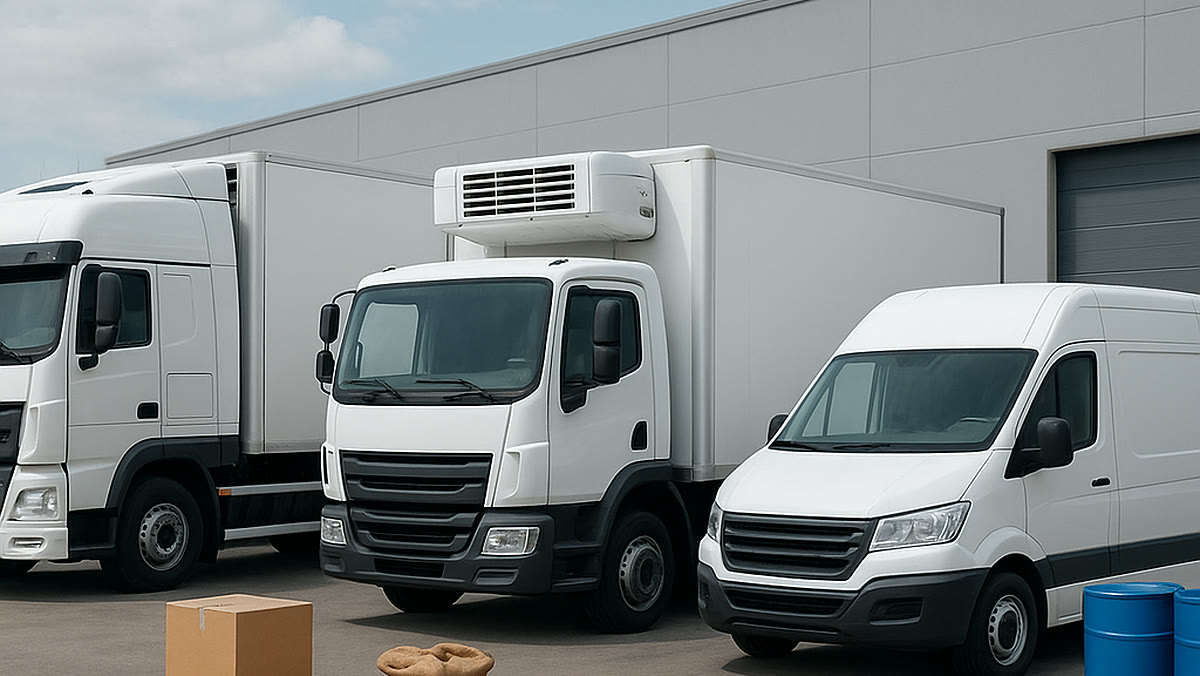
Each type of vehicle is built for its own delivery scenario. A van wins on manoeuvrability and speed of availability, a curtain-side truck on capacity, and a reefer on its ability to maintain a controlled temperature. So which vehicle is needed is determined not only by the trip price but also by the characteristics of the cargo and the route.
| Criterion | Van | Curtain-side truck | Reefer |
|---|---|---|---|
| Payload | ≈1.5–2 t | 20–22 t, up to 24 t for some models | Up to 20–22 t depending on the body |
| Capacity | ≈15–20 m³ — small batches | 82–92 m³, 33 EUR pallets on the floor | Less than a curtain-sider of the same length, due to insulation |
| Temperature control | Usually none | None in the standard version | Present, within a set range |
| City routes | Very convenient | Limited access | Depends on dimensions |
| Availability speed | Often the highest | Requires planning | Depends on availability and regime |
| Cost-effectiveness | Small batches and urgent deliveries | Large volumes and long-haul trips | Temperature-sensitive goods |
Van: speed and access in the city
A van is optimal for small loads, urgent orders and delivery straight to the door. It gets into yards, shopping centres and narrow streets more easily, and it's often simpler to arrange its availability on short notice. It's a practical option for clothing, boxes, household appliances, small furniture and local moves.
At the same time, a van has limits on weight, volume and the ability to carry temperature-sensitive goods. If its body isn't equipped with refrigeration, it won't replace a reefer. For a large batch of goods, several vans can end up more expensive than a single curtain-side truck: by tonnage, one curtain-side semi-trailer equals roughly ten van trips, even if each individual trip seems affordable.
Curtain-Side Truck and Reefer: Capacity versus Specialisation
A curtain-side truck is economically justified when a significant volume of cargo needs to move over a medium or long distance. It works well for palletised goods, building materials, textiles, furniture and large household appliances. The cost per unit of goods at full load is usually lower than when using several small vehicles. The range of full-truckload rates is broken down in the article "How Much a Curtain-Side Truck Costs Across Ukraine in September 2026".
The drawback of a curtain-side truck is its large dimensions: under clause 22.5 of the Traffic Rules, an articulated road train can be up to 18.75 m long (a road train with a trailer — up to 22 m), 2.6 m wide and 4 m high. Because of this, it can struggle to reach a city address, may need special room to manoeuvre, and requires the loading time to be agreed in advance. For a fast delivery of a small batch, it's often an oversized solution.
A reefer is chosen for frozen products, fresh produce, some medicines and goods that need a stable temperature regime (more detail — reefer transport). This type of vehicle is more expensive to operate because of the refrigeration equipment, temperature control and the higher requirements for preparing the body, and because of the wall insulation its internal volume is smaller than that of a curtain-side semi-trailer of the same length. But saving money by using an ordinary vehicle can spoil the cargo, so reliability matters more here than the lowest price.
Cost-effective transport isn't the cheapest vehicle — it's the one that matches the cargo without unnecessary risk.
Before booking, it's worth comparing the batch volume, the distance, the delivery deadline and the unloading conditions. That makes it easier to determine which vehicle is needed for a specific trip.
Common mistakes when choosing transport for cargo
Focusing only on the lowest price
The cheapest offer doesn't always mean a good deal. A low rate can point to the wrong body type, missing equipment, or an incomplete list of services. If the cargo gets damaged, delayed, or loses its market condition, the costs of returns, replacement and redelivery will outweigh the initial savings.
Before booking, you need to compare not just the price per trip but also the terms of insurance, vehicle availability, loading, unloading, detention and extra stops. It's important to clarify in advance whether the price includes securing materials, temperature control, driver assistance and the preparation of accompanying documents. That's the way to understand which vehicle is needed, rather than choosing a vehicle purely on an advertised number.
Exceeding the payload and running short of space
One of the most common mistakes is going by the number of boxes without exact data on their weight and dimensions. Even if the cargo physically fits into the body, that doesn't mean the vehicle can carry it safely. Exceeding the permitted mass worsens handling, increases braking distance, and creates a risk of road damage or being stopped during an inspection. The Government Rules for the Movement of Oversized and Overweight Vehicles (Cabinet of Ministers of Ukraine Resolution No. 30 of 18 January 2001) limit the total mass of a road train to 40 t (44 t for combined transport of a container to a port or terminal), and the axle load to 11 t on a single axle, 16 t on a tandem axle and 22 t on a tri-axle bogie. An axle can be overloaded even when the total mass is formally within the norm.
The opposite problem is running short of volume. Light but bulky goods, such as furniture, textiles or insulation material, can fill the body completely long before the maximum weight is reached. Before the vehicle arrives, it's worth preparing a list of items with the dimensions and mass of every pallet or package.
- check the total weight and volume of the cargo;
- clarify the internal dimensions of the body and the loading height;
- allow room for aisles, padding and securing;
- find out whether a tail lift, a crane or a forklift is needed.
The wrong temperature regime and problems with documents
An ordinary van or a dry curtain-side truck won't replace a reefer when carrying frozen products, fresh produce or medicines. The mistake can lie not only in the choice of vehicle but also in setting the wrong temperature. The body needs to be pre-cooled, and for sensitive goods the readings need to be monitored throughout the whole route.
The loading method should be checked separately. Top, side or rear loading requires different equipment, and fragile items can't simply be stacked without securing. Incorrect placement leads to impacts, tipping and deformed packaging.
Problems also arise from incomplete documents: an inaccurate cargo description, or a missing consignment note, certificates, permits or special labelling. Dangerous goods require additional requirements for the vehicle, the driver and the accompanying paperwork. So before the trip, all the data, the acceptance conditions and the consignee's requirements should be checked, rather than relying only on a verbal agreement.
FAQ: answers to popular questions about choosing transport
Which vehicle is needed for a small batch of cargo?
For a small batch, a van is most often enough. It suits boxes, clothing, textiles, household appliances, small furniture and goods for delivery within a city or between neighbouring towns. A van is manoeuvrable, can get closer to the consignee's address, and is usually made available for loading faster.
If the cargo takes up several pallets, has a significant mass, or needs to travel a long distance, it makes more sense to consider a light truck or a curtain-side truck. The choice depends on what limits the shipment — weight or volume. Light but bulky goods may need a larger body, even if their total mass is small. That's exactly why, before booking, the carrier needs to be told the number of items, the dimensions and the weight of each package.
When to choose a reefer, and can different cargo be combined?
A reefer is needed when the cargo has a defined temperature regime. This applies to frozen products, some fresh vegetables and fruit, dairy products, flowers, and also medicines for which the manufacturer sets temperature requirements. It's important to clarify not only the desired range but also the permitted time the goods can spend outside refrigeration equipment during loading and unloading.
Different cargo can travel in the same truck if it's compatible in temperature, odours, sanitary requirements, packaging and product-compatibility rules. For example, dry boxed goods can be combined provided there's reliable separation and securing. On the other hand, strong-smelling products, chemicals, medicines and goods with different temperature regimes shouldn't be combined without a special assessment. For reefer transport, it's also necessary to consider whether the specific cargo allows shared refrigeration.
How to calculate volume, and what data to prepare for booking?
The volume of a single rectangular package is calculated by multiplying its length, width and height, converted to the same units of measurement. The figures for all the items are then added together, with an allowance added for safe stacking, padding and securing. For reference: a EUR pallet has a base of 0.8 × 1.2 m, and the internal dimensions of a standard curtain-side semi-trailer are roughly 13.6 × 2.45 × 2.7 m, meaning three pallets across and 11 rows on the floor. For pallets, it's important to state not just their number but also whether the size is standard or non-standard, the height, and whether they can be stacked.
For the carrier to correctly determine which vehicle is needed, prepare a cargo description, the total weight, the number of items, the dimensions, the packaging type, the temperature requirements, the addresses, the desired dates and the loading method. It's also worth reporting the presence of stairs, a ramp, a narrow approach, time restrictions and the need for a tail lift. The more accurate the data, the lower the risk of a surcharge, detention or a vehicle swap on the day of delivery.
Conclusion: how to quickly determine which vehicle your cargo actually needs
To quickly determine which vehicle your cargo needs, first record its main characteristics: total weight, number of items, dimensions, volume, packaging type and whether it can be stacked. It's important to separately check exactly what limits the shipment — mass or capacity. Light but bulky goods may need a large body, while a heavy load needs a vehicle with the appropriate payload and reliable securing.
Next, define the special conditions. Frozen products, fresh produce, flowers and some medicines need a reefer with the appropriate temperature regime. Dangerous goods require specially equipped transport, labelling and a full set of documents. Furniture, equipment and fragile items need protection from impact, while palletised goods need a convenient loading method and securing.
After that, match the cargo's characteristics to the route. A van is best suited for small batches, urgent deliveries and city addresses. A curtain-side truck is worthwhile for large volumes, pallets and long-haul trips, while a reefer suits temperature-sensitive goods. Before booking, tell the carrier the addresses, the route length, the desired deadline, any access specifics and the unloading conditions. Choose a vehicle with a moderate margin in capacity and payload: this reduces the risk of overloading, cargo damage, delays and unforeseen costs.

Related posts

Do you have cargo or transport?
Post your offer — and find the right partner today.