What Happens If 20 Tonnes of Cargo Are Loaded Unevenly Onto a Truck
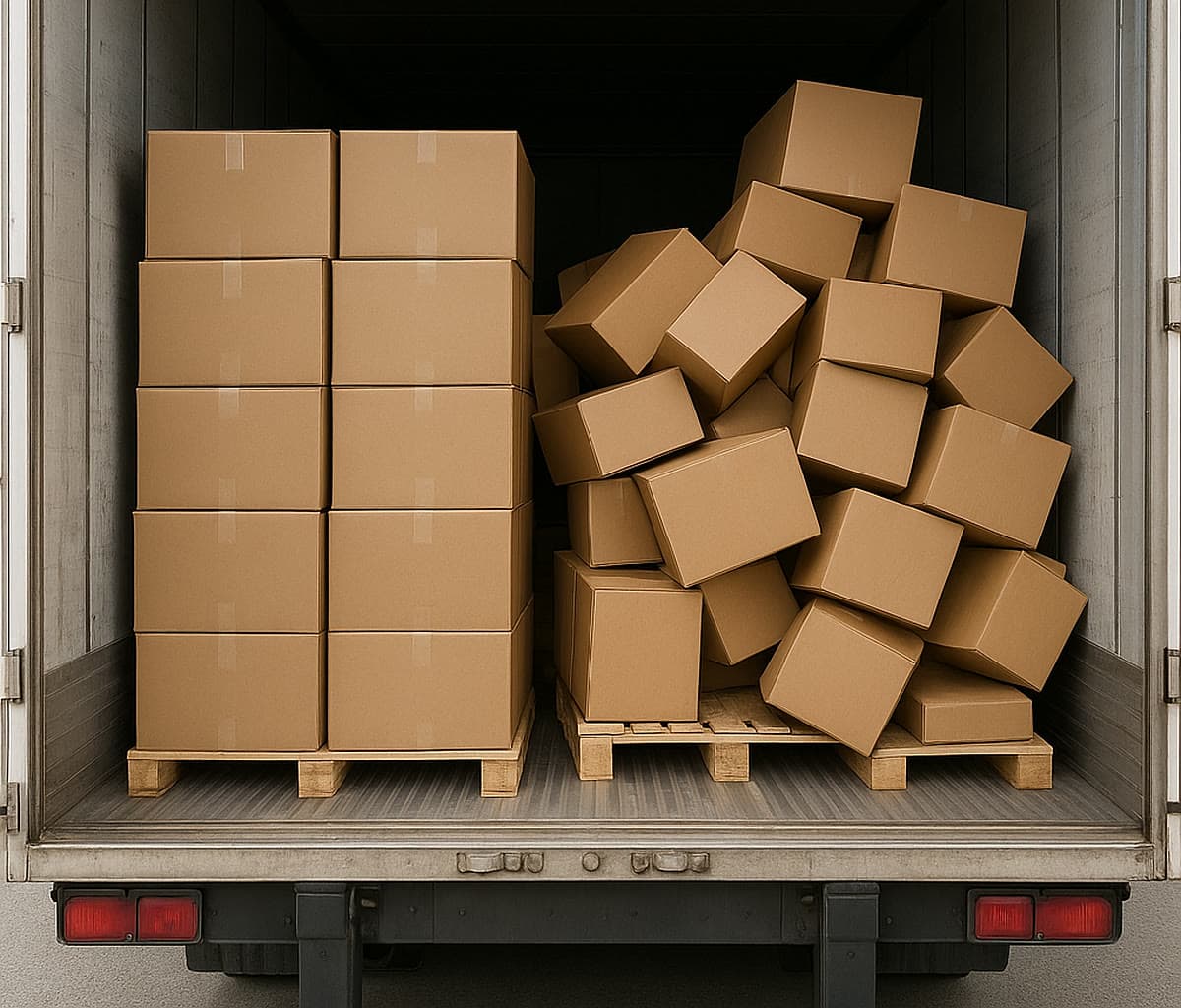
Loading 20 tonnes onto a truck unevenly: why it creates danger
What happens to the centre of gravity when 20 tonnes are out of place
Twenty tonnes of cargo is a substantial mass that, while moving, acts as more than static ballast. If you load a truck unevenly, the road train's centre of gravity shifts sideways, forward, or backward. As a result, the trailer can behave unpredictably even when the total mass does not exceed the limit allowed for that particular vehicle.
The most dangerous situation arises when heavy pallets or individual items are concentrated in one spot. Excessive loading toward the rear of the semi-trailer unloads the fifth-wheel coupling and, with it, the tractor's drive axle: traction under power and under braking drops, and the road train becomes more prone to jack-knifing. If most of the mass sits toward the front of the semi-trailer, the load on the fifth-wheel coupling and the tractor increases. An imbalance between the axles can also cause the permitted axle loads to be exceeded.
How this affects stability, braking, and handling
During a turn, the cargo generates a lateral force that tends to push the trailer outward. The higher the centre of gravity, the greater the risk of roll. That's why heavy items are usually placed as low as possible, spread evenly along the load compartment and between the left and right sides.
If the mass is distributed unevenly, the truck can:
- retain inertia longer during emergency braking;
- deviate from its path or create a jack-knifing effect in the road train;
- lose stability on turns, descents, and while changing lanes;
- put uneven load on the tyres, suspension, and braking system;
- trigger cargo shift if it was not secured well enough.
The combination of uneven distribution and weak securing is especially dangerous. In that case, a sharp manoeuvre can shift the pallets, and the centre of gravity can change mid-route. The driver effectively loses the vehicle's predictable response. Even modern electronic stability systems cannot fully compensate for a physically incorrect load.
Why the consequences aren't only the driver's problem
An unstable truck is a hazard to every road user. A sharp deviation of the trailer can force nearby vehicles into emergency braking or into another lane. Uneven pressure also damages the road surface, an overloaded axle speeds up wear on tyres and running-gear parts, and damaged cargo creates financial claims against the carrier.
Before departure, you need to check not only the total mass but also the load on each axle, the position of the centre of gravity, the condition of the securing, and whether the loading scheme matches the specifications of the tractor and semi-trailer. It is exactly this kind of comprehensive control that helps avoid a situation where a formally permitted 20 tonnes turns into a serious road risk.
How the truck's road behaviour changes
Shifted centre of gravity: the truck reacts late
When cargo is loaded unevenly onto a truck, it's not only the axle loads that change — the whole behaviour of the road train changes. Twenty tonnes concentrated closer to one edge, the rear, or stacked high create a shifted centre of gravity. The driver may feel this as a sluggish steering response, trailer sway, or a sudden deviation from the intended path.
When changing lanes, the trailer doesn't always mirror the tractor's movement right away. The trailer first leans, then can perform a sharp counter-motion. On a wet, snow-covered, or uneven road, this delay raises the risk of a skid. The situation becomes especially difficult when the driver tries to sharply correct the trajectory: over-steering can amplify the sway.
The danger grows on turns. If heavy pallets stand unevenly or are shifted to one side, the lateral load is distributed unequally. Tyres on one side can take excessive pressure while the others lose some grip. Under an unfavourable combination of speed, turn radius, and road conditions, this can lead to critical roll and the trailer overturning.
Braking, skidding, and axle overload
Improper cargo placement often increases the braking distance. The 20-tonne mass alone requires significant energy to stop, and a shifted centre of gravity further affects how the braking system performs. If some axles are overloaded while others are not pressed firmly enough onto the road, the wheels can brake unevenly. This worsens stability and raises the risk of lock-up or loss of grip.
When most of the mass sits toward the rear of the semi-trailer, the fifth wheel and the tractor's drive axle receive too little vertical load, and the front axle is unloaded along with them. Traction, braking, and handling all deteriorate in that case, especially on a slippery surface. If, on the other hand, the cargo is shifted too far forward, pressure on the fifth-wheel coupling and drive axles increases, and the tyres, suspension, and brakes wear out faster.
- In a turn: roll, sway, and the trailer running off its path are all possible.
- Under braking: stopping distance increases, along with the risk of the road train jack-knifing.
- On a slippery road: the grip margin shrinks and the chance of a skid rises.
- With an overloaded axle: tyre and running-gear wear accelerates.
It's important to understand: stability systems help reduce the consequences of mistakes, but they do not fix a dangerous loading scheme. Before the trip, you need to check not just the total mass, but the actual load on the axles, the stacking height, and how securely each section of cargo is fastened.
A permitted gross weight does not mean the load is safely distributed across all the axles.
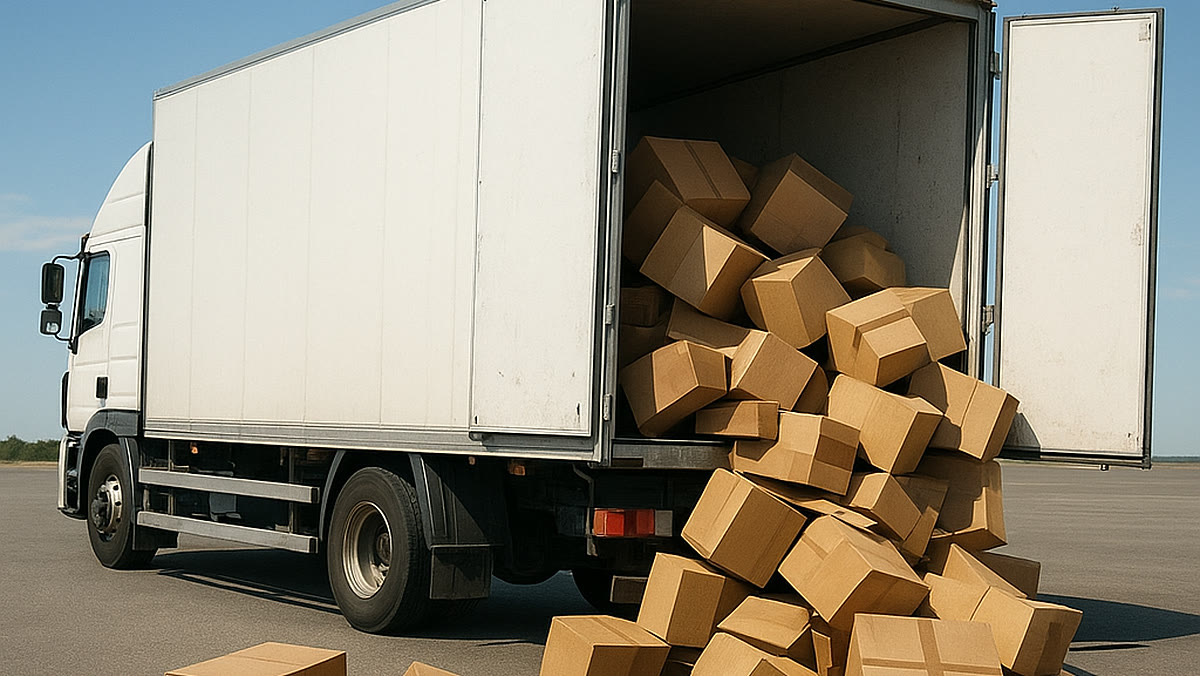
What violations and losses are possible in Ukraine
When 20 tonnes turn into an axle overload
The figure of 20 tonnes by itself doesn't automatically mean a violation. What's assessed is not only the road train's total mass, but also the permitted load on each axle, the number of axles, the technical specifications of the tractor and semi-trailer, and the restrictions on a specific road. That's why a situation where cargo is loaded onto a truck unevenly can be a problem even when the formal gross weight is within limits.
Violations are detected during weight-and-dimension control. If part of the cargo is concentrated over one group of axles, the scales can register an axle-load excess specifically. This is a separate risk, since excessive pressure on the road surface speeds up rutting, subsidence, and asphalt failure. On individual bridges, sections during the thaw period, or during seasonal restrictions, the permitted parameters can be lower.
The baseline weight standards for Ukraine are set by the rules on the movement of oversized and overweight vehicles (Cabinet of Ministers Resolution of 18 January 2001 No. 30): the permitted gross weight of a road train is 40 t (44 t for combined transport of a container to and from a sea port or terminal), the load on a single axle is 11 t, on a tandem (dual) axle group — 16 t, on a tridem (triple) axle group — 22 t. Dimensions are limited by clause 22.5 of the Road Traffic Rules: width — 2.6 m, height — 4.0 m, length — 12 m for a single truck, 18.75 m for an articulated (tractor-semi-trailer) road train, and 22 m for a road train with a drawbar trailer. That's exactly why 20 t of cargo usually fits within the overall limit but easily exceeds the axle limit if the mass is gathered over one group of axles.
Administrative liability applies in Ukraine for exceeding weight or dimension standards. The size of the fine depends on the extent of the excess, the type of violation, and the current version of the legislation. A separate fee for the passage of an oversized/overweight vehicle can also be charged, and movement can be restricted until the violation is corrected. The exact amount is determined based on the results of official control, so relying only on the total cargo mass is incorrect.
What losses and liability can arise
The consequences of improper loading aren't limited to a fine. During sharp braking or a turn, unsecured pallets can damage the packaging, the goods, and the interior of the semi-trailer. Excessive load on one axle speeds up wear on the tyres, suspension, hubs, and braking system. If damage occurs en route, the carrier can lose time on repairs and incur costs for reloading or returning the cargo. The trip profitability calculator helps work out how much such a disruption eats into your margin.
How liability is distributed depends on the circumstances of the shipment and the terms of the contract. The driver, the carrier, the vehicle owner, the shipper, or the party that actually performed the loading can all be brought into the review. The consignment note, the loading scheme, the weight-control data, and evidence of who determined how the cargo was placed all carry significant weight.
- For the carrier: fines, downtime, repairs, and claims from the client.
- For the shipper: compensation for damaged goods if the mistake was made during loading.
- For the driver: administrative consequences if they accepted a dangerous load or continued driving with an obvious violation.
- For the road owner and other road users: the risk of an accident, damage to the surface, and property losses.
To reduce the risks, before departure you should check the total mass and axle loads, secure the cargo, keep the documents, and not set off on the route until a detected excess has been corrected.
How to properly distribute 20 tonnes in a truck
Start by checking the permitted parameters
Before loading, you need to determine not only the total mass of 20 tonnes but also the permitted load on each axle of the tractor and semi-trailer. A 20-tonne trip is a typical order on the exchange, and we covered how much it costs to transport 20 tonnes on the main routes separately. These values are stated in the registration documents, on the vehicle's information plates, or in the manufacturer's technical documentation. You should also account for the mass of the tractor itself, the semi-trailer, fuel, the driver, and any additional equipment.
Separately, check route restrictions in Ukraine: temporary seasonal bans, restrictions on bridges, and sections with insufficient load-bearing capacity. The total mass permitted for one road train doesn't replace checking the axle loads. That's why, before departure, it's a good idea to use certified scales or turn to a weighing station if the calculation raises doubts.
How to place heavy items and calculate the load
Work out the loading scheme before the truck is even brought to the ramp. In a standard curtain-side semi-trailer, the interior dimensions are ≈13.6 × 2.45 × 2.7 m, 33 Euro pallets fit on the floor, and the permitted load is 20–22 t. So 20 t works out to roughly 600 kg per pallet on average — and it really is only "on average": real-world items are almost never the same weight. Determine the mass of each pallet, drum, container, or other unit, then distribute it along the floor of the semi-trailer. Heavy units are placed as low as possible, without concentrating them near the rear wall, the front wall, or just one side.
You should aim for an even balance between the left and right sides, as well as between axle groups. At the same time, you can't simply divide 20 tonnes into equal parts mechanically: the actual result depends on the wheelbase, axle positions, the fifth-wheel coupling, and the geometry of the load compartment. The correct scheme is calculated from the technical data of the specific road train.
Safe loading isn't just about placing the cargo inside the body — it's about ensuring a permitted load on every axle.
If part of the cargo is lighter, it can be placed on upper tiers, but only if the stacking is stable (for more on tiering and load compatibility, see the article on pallets and consolidated cargo). The cargo must not block the doors, create a dangerous tilt, or exceed the permitted height. Fragile and unstable items are kept separate from heavy ones so they don't get crushed under braking.
Secure the cargo and carry out a check before departure
Straps, chocks, anti-roll bars, spreader bars, partitions, and anti-slip mats are used for securing, depending on the type of cargo. Straps must be in good condition, free of cuts, and with undamaged buckles. Securing is tensioned so the cargo cannot shift forward, backward, or sideways during a sharp manoeuvre.
- check the actual mass of every item against the consignment notes;
- check the symmetry of the placement and the absence of dangerous gaps;
- inspect the straps, chocks, and corner protectors;
- make sure the doors and side panels are securely closed;
- if possible, carry out a control weighing by axle;
- stop after the first few kilometres and re-check the securing.
If there is a risk of loading a truck unevenly, the situation shouldn't be corrected with speed or more careful steering. The safe solution is to stop the loading, change the scheme, or reload the cargo before the trip begins.
FAQ: answers to questions about cargo distribution in a truck
Can all the heavy cargo be placed near the front or the rear?
No, that kind of placement usually creates a dangerous overload of individual axles and worsens handling. If the mass is concentrated near the front of the semi-trailer, the load on the fifth-wheel coupling and the tractor's drive axles increases. Excessive mass near the rear wall, on the other hand, unloads the fifth wheel and the tractor's drive axle, which worsens traction, braking, and steering response, and raises the risk of the trailer swaying.
Heavy items are placed as low as possible and distributed along the load compartment according to a scheme calculated for the specific tractor and semi-trailer. You can't just split 20 tonnes into notionally equal parts: what matters is the position of the axles, the wheelbase length, the distance to the fifth wheel, and the suspension's characteristics. If cargo is loaded onto a truck unevenly, a permitted gross weight does not guarantee a safe load on the axles.
Who is liable for the mistake, and how do you check the axle load?
Liability is determined by the specific circumstances of the shipment. The driver must check the condition of the cargo, its securing, and any obvious signs of dangerous loading before departure. The carrier is responsible for organising the trip and the technical condition of the vehicle, and the shipper or warehouse operator can be liable for mistakes in weight, the loading scheme, or the actual load if they were the ones who carried out that work.
Truck scales or special weighing complexes are used for precise control, letting you determine the total mass and the load on individual axles or axle groups. The data needs to be compared against the technical documents for the tractor, the semi-trailer, and the route's requirements. An "eyeballed" estimate doesn't replace weighing, especially when the cargo consists of pallets of different weights or has an unknown actual centre of gravity.
What to do if the cargo has already shifted en route?
You need to smoothly reduce speed, avoid sharp braking and sharp turns, and stop in a safe place as soon as road conditions allow. You should not open the semi-trailer doors on a slope or right after a sharp stop: shifted pallets can fall out.
After stopping, the driver should inspect the securing only when it's safe to do so, and notify the dispatcher or carrier. If the cargo is damaged, the doors are deformed, or there is a risk of the trailer overturning, professional help and reloading are needed. Driving can only continue once the cargo has been securely fastened again and it's confirmed that the axle loads remain within the permitted limits.
Conclusion: uneven cargo distribution in a truck can turn a shipment into an accident risk
If cargo is loaded onto a truck unevenly, even 20 tonnes that are permitted on paper can create a serious risk. A shifted centre of gravity worsens handling, increases the braking distance, causes the trailer to sway and skid, and can lead to overturning during a sharp turn.
Uneven loading also causes individual axles to exceed their permitted values. This risks fines, restrictions on further movement, accelerated wear on tyres, suspension, and brakes, damage to the road surface, and damage to the cargo itself. In the event of an accident, liability can be split between the driver, the carrier, the vehicle owner, and the parties involved in loading — depending on who made the mistake.
Safely transporting 20 tonnes starts with the loading scheme. You need to check the technical limits of the tractor and semi-trailer, the permitted gross weight, and the load on each axle, as well as the requirements of the specific route. Heavy items are placed low and evenly, without concentrating them near the front or rear or against one side.
Before departure, the cargo must be securely fastened with straps, chocks, or spreader devices in good condition, the actual mass checked against the documents, and, if possible, a control weighing carried out. If the cargo has shifted en route, you should stop safely, not open the doors under the risk of goods falling out, and fix the problem before continuing. This kind of control protects not only the carrier's property but the lives of everyone on the road.

Related posts




Do you have cargo or transport?
Post your offer — and find the right partner today.