Why Two Identical Trucks Can Run the Same Route for UAH 30,000 and UAH 45,000
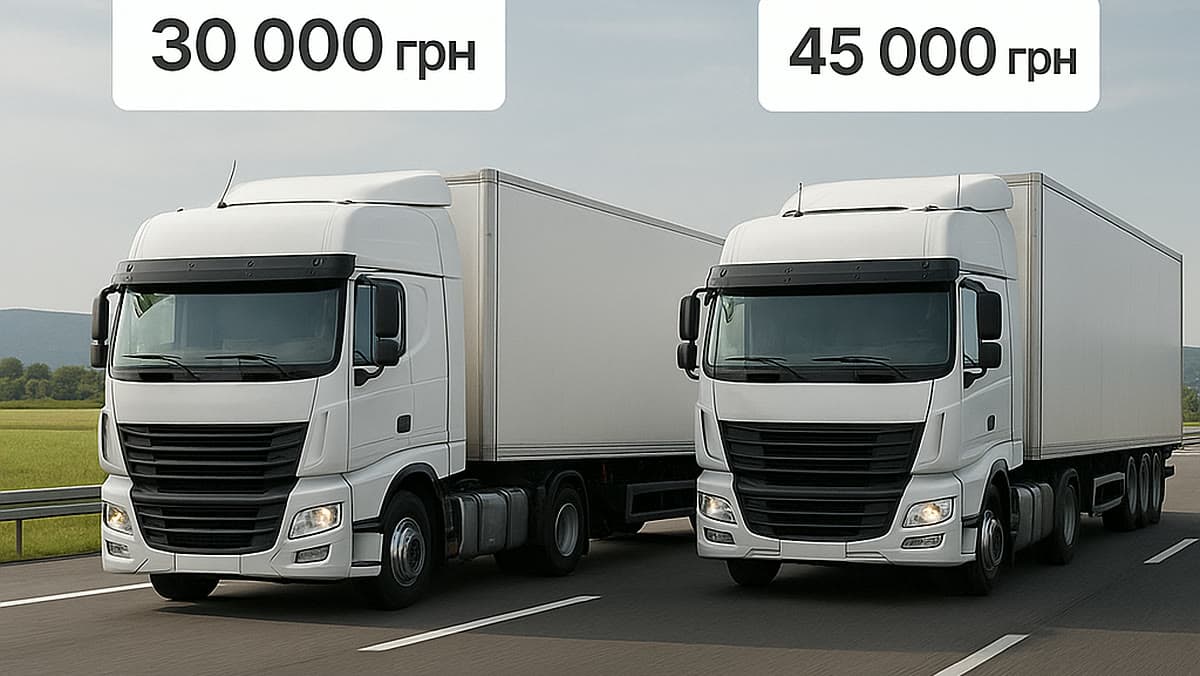
Why the price gap on an identical route can reach UAH 15,000
An identical truck doesn't mean an identical carrier
At first glance two trucks can look completely identical: the same curtain-side semi-trailer, a similar body volume and the same route — say, from Kyiv to Lviv, roughly 540 km. Yet the cost of a trip isn't shaped only by the vehicle type and the number of kilometres. That's exactly why a price gap between offers of UAH 30,000 and UAH 45,000 doesn't necessarily mean one carrier is trying to overcharge: for a full 20–22 t truck on that leg, rates in September 2026 held roughly within UAH 32,000–45,000, so UAH 30,000 sits even a bit below the usual lower bound, and UAH 45,000 near the upper one. For an international trip, say to Poland, the range is entirely different, so it's only correct to compare two offers within the same route.
The price includes a whole set of costs: fuel, driver pay, toll roads, insurance, taxes, maintenance, border waiting time and risks tied to the specific cargo. It also matters whether the truck is already near the loading point or has to run empty from another region.
Five key reasons that change the rate
Even with the same destination, carriers can calculate a trip under different conditions. The sum is most often affected by:
- Empty running. If a truck ends up near the warehouse after a previous order, its costs are lower. A truck that has to be brought in specially from hundreds of kilometres away will cost more.
- Urgency. A "for tomorrow" trip, night loading or a tight delivery time narrow the choice of transport. For being ready to work without a time buffer, a carrier may set a higher rate.
- Border conditions and route. For an international trip, queues, toll motorways, permits, customs escort and the risk of a long wait matter. Even a small route change can add cost.
- Cargo type. Dangerous, fragile, temperature-sensitive or expensive goods require extra insurance, special equipment or increased liability.
- Financial and contractual terms. A lower offer may exclude VAT, insurance, extra loading, unloading or waiting time. Another company includes these services in the final sum right away.
What to actually compare instead of one number
Before choosing, it's worth asking both carriers for a detailed calculation. In September 2026, about two-thirds of cargo listings on SAMO-TRANS were published marked "price by agreement," so the final sum has to be agreed in correspondence anyway — and that's exactly when it's worth pinning down what it includes. It's important to clarify the body type, payload, loading date, number of loading and delivery points, allowed waiting time and the list of included services.
| Parameter | What to check |
|---|---|
| Price | Whether VAT, insurance, toll roads and extra fees are included |
| Timing | When the truck is supplied and what the guaranteed delivery time is |
| Risks | Who pays for waiting time, reloading or a border delay |
So a UAH 15,000 price gap is often explained not by the truck itself, but by the level of service, the transparency of the calculation and the risks the carrier takes on. A cheaper offer can be a good deal, but only after checking all the terms of the contract.
What goes into the rate: route, cargo and shipping terms
Distance is only the start of the calculation
A carrier doesn't just multiply the distance between cities by a rate per kilometre. The rate factors in the actual route, road conditions, possible detours, toll sections, border crossing and empty running. If the truck has no return order after unloading, part of the cost of the return trip may be included in the price of the current one.
For domestic transport, the difference comes from traffic jams, seasonal traffic restrictions, stops at several warehouses and how hard it is to access the delivery point. On international trips, costs for permits, road tolls, waiting time and customs procedures are added. So the same start and finish points still don't guarantee the same cost.
Kilometres show the length of the route, but not its real complexity.
Cargo shapes the requirements for the vehicle and liability
Two trucks can carry cargo of the same volume but with different weight, value and risk level. Weight affects fuel costs, the ability to use certain roads and the load on the vehicle. If the cargo is heavy but takes up little space, it's important not to exceed axle limits: under the rules for the movement of oversize and overweight vehicles (Cabinet of Ministers of Ukraine Resolution No. 30 of 18 January 2001), the maximum gross weight of a road train in Ukraine cannot exceed 40 t (44 t for combined transport of a container to a port or terminal and back), the load on a single axle is 11 t, on a tandem axle 16 t, and on a triple axle 22 t. If the cargo is light and bulky, the truck can be full before reaching maximum payload.
The properties of the goods also affect the price. Fragile cargo needs reliable securing, expensive cargo needs extended insurance coverage, and temperature-sensitive products need a reefer and temperature control for the whole trip. Dangerous goods may require special documents, labelling and driver clearances.
- Curtain-side truck (tilt trailer) takes 20–22 t and 82–92 m³, i.e. 33 EUR pallets on the floor, suits standard pallets and boxes, but doesn't provide a stable temperature.
- Reefer burns extra fuel to run the refrigeration unit.
- A vehicle for dangerous goods needs special equipment and compliance with additional rules.
- Oversized or non-standard cargo may require route approval and an escort.
Urgency, loading and unloading
When a truck has to be supplied not in a few days but within a few hours, the carrier has fewer chances to find a profitable return trip. An urgent order often means paying to reserve the vehicle, working on weekends or at night, and a higher risk of waiting time.
Just as important is who does the loading work. If the warehouse has no forklift, and a tail lift, manual unloading or several addresses are needed, this extends the trip. Waiting beyond the agreed time, a repeat supply of the truck and an address change may be billed separately.
It's exactly these details that often shape the price gap between UAH 30,000 and UAH 45,000. It's worth comparing not just the sum but the full list of terms: route, cargo type, timing, temperature regime, loading, unloading and liability for waiting time.

Fuel, toll roads and waiting time: the hidden components of the cost
Fuel: the rate doesn't depend on distance alone
Fuel is one of the largest components of a trip's cost. As of 17 September 2026, the average diesel price in Ukraine is UAH 98.24/l (fuel prices), so at a consumption of 32 l/100 km, a kilometre of the trip takes about UAH 31 in fuel alone: over a 540 km leg that's roughly UAH 17,000, i.e. more than half of the lower of the two offers. If the truck returns empty, twice as much fuel is needed — we calculated these losses in "A truck returns empty: the cost of deadhead running". A carrier accounts not only for the kilometres between the loading and unloading points, but also for the approach to the warehouse, detours, finding a safe place to park and possible empty running after delivery. If the route runs through traffic jams, mountain sections or roads with frequent speed limits, actual fuel consumption can be higher than calculated.
The moment the contract is signed also affects the price. When the price of diesel changes, the carrier either builds a fuel reserve into the rate or allows for the possibility of adjusting it. In peak shipping season, in particular before holidays or during active exports, fewer vehicles are available and demand is higher. Because of this, even the same route can cost differently on different days.
A transport rate pays not only for the truck's movement, but also for the time and resources needed to complete the whole trip.
Toll roads and extra kilometres
On international routes, road tolls, vignettes or payment for certain motorways can be added to the base rate. A carrier chooses between a shorter toll route and a longer free one, but the decision depends on the deadline, restrictions for trucks and the projected time on the road. So two companies can offer different sums by using different routes.
Extra kilometres also arise when a truck picks up cargo at several places, stops at a customs terminal, or has to detour around road repairs. If such deviations aren't discussed in advance, the final bill can grow because of a surcharge for every kilometre, waiting, or a repeat supply of the vehicle.
Waiting time at the warehouse and the border
Waiting time often stays invisible to the customer, even though the truck is using up resources at that moment and can't run another trip. A delay arises from cargo not being ready, a loading queue, missing documents, faulty equipment or a long wait at border control.
The contract usually sets a free waiting period and a rate for waiting beyond it. For a domestic trip that can be a few hours, while on an international route a delay sometimes depends on the queue and the work of control services. One carrier includes the waiting-time risk in the overall rate, another shows it as a separate charge. That's exactly why the price gap between offers can reach thousands of hryvnias even for an identical truck.
Before ordering, it's worth clarifying whether the rate includes fuel, road tolls, detours, paid terminals, waiting time and extra kilometres. Such a breakdown helps see the real cost of the shipment, not just an attractive headline figure.
What sets carriers apart with the same type of truck
Experience and reliability have their price
The same type of truck doesn't mean the same level of carrier. A company that has worked a specific direction for years knows the features of border crossings, warehouse requirements, typical delays and safe parking spots better. It can estimate travel time more accurately and prepare documents in advance. This experience reduces the risk of a failed delivery, though it often raises the rate too.
A new or little-known carrier sometimes offers a lower rate to attract a client. But its calculation may not account for waiting time, extra kilometres or the complexity of customs clearance. As a result, the initial price grows during the trip itself. That's exactly why the price gap can be payment not just for the trip, but for the predictability of the outcome.
Fleet condition, insurance and documents
The condition of the vehicle directly affects the risk of delay. Regular maintenance, sound tyres, brakes, refrigeration equipment and monitoring systems reduce the chance of a breakdown on the road. A carrier that keeps its fleet in proper condition has higher service and part-replacement costs, so its rate won't always be the lowest.
For international transport, valid registration documents, transport permits, liability insurance and cargo documents matter. If the goods have special requirements, extra certificates, customs documents or confirmation of the temperature regime may be needed. Missing even one document can lead to a border delay and unforeseen costs.
- Cargo insurance determines which risks are covered and up to what sum.
- Permits and documents must match the route, cargo type and transit countries.
- Technical condition affects the likelihood of a breakdown and meeting delivery deadlines.
- Communication system allows the client to be quickly informed of a change in circumstances.
What a freight forwarder adds to the cost
A freight forwarder doesn't just pass the listing on to a driver. They search for transport, check the carrier's documents and reputation, coordinate loading, monitor movement and help resolve disputes. For this, a commission or a separate fee for organising the shipment is added to the base rate.
In a cheaper offer, forwarder support may be minimal: the customer checks the vehicle, controls the documents and communicates with the driver themselves. In a more expensive rate, these operations are already included in the service. Before signing the listing, it's worth clarifying who is responsible for an insurance case, waiting time, replacing the vehicle and informing about the trip's status. Then the price gap becomes clear, and comparing offers becomes correct.
FAQ: how to check whether a UAH 30,000 offer is really more profitable
How to compare two commercial offers
An offer of UAH 30,000 really can be more profitable, but only when both carriers calculate the trip under the same conditions. It's necessary to compare not just the final sum, but the route, supply date, body type, payload, number of addresses, delivery time and the list of included services.
Ask the carrier to provide the calculation in writing. It should state the sum, currency, whether VAT is included, payment terms and the rate's validity period. If one carrier quotes a price without taxes or without toll-road costs, while another states the full sum right away, that price gap is only formal.
| What to clarify | Why it matters |
|---|---|
| What's included in the rate | Helps spot fuel, roads, insurance and forwarding services that might not have been accounted for |
| Number of points | Every extra stop can increase time and mileage |
| Waiting-time terms | Shows who will pay for waiting at the warehouse or border |
| Delivery time | Lets you compare a regular and an urgent trip |
What hidden surcharges can appear
Before confirming an order, it's worth directly asking whether the cost of loading and unloading, supplying the vehicle, the customs terminal, toll roads, extra kilometres, insurance and paperwork are included. It's also important to know whether there's free waiting time and what the hourly rate is once it ends.
Separately, clarify the terms for changing the route, address or loading time. Some carriers consider such changes an extra service. If the agreements stay only verbal, in an unusual situation it's hard to prove that a certain charge wasn't envisaged. It's more reliable to fix all the terms in the listing or the contract.
Is a cheaper offer dangerous
A low rate by itself doesn't signal a problem. A carrier may have a vehicle near the loading point, a free return trip or lower administrative costs. The risk appears when a company avoids specific answers, doesn't confirm documents, doesn't name the vehicle's details, or offers to significantly change the price after loading.
Before signing the deal, check the company's registration data, reviews, insurance document, permit papers and the contacts of the person in charge. Ask who will replace the vehicle in case of a breakdown, who will compensate for waiting time, and how the cargo will be tracked. If the terms are the same, UAH 30,000 may be the better choice. But if the cheap rate doesn't cover important risks, a price gap of UAH 15,000 may turn out to be the cost of unforeseen expenses.
Conclusion: how to properly assess the price gap in freight transport
Two identical trucks can run the same route for UAH 30,000 and UAH 45,000, because the vehicle is only one component of the rate. The final sum is affected by mileage and empty running, the price of fuel, toll roads, seasonal demand, urgency, the weight and features of the cargo, and the number of loading and unloading points.
Separately, you need to account for waiting time at warehouses and the border, temperature requirements, insurance, permit documents, the vehicle's technical condition and the carrier's experience. Some companies build these costs into the rate, while others quote only the base price and then add payment for waiting, extra kilometres or escort.
So a price gap doesn't always mean an overpayment. A more expensive offer may include a sound and backup vehicle, full insurance, delivery tracking, transparent waiting-time terms and the carrier's accountability for the result. At the same time, a lower rate can be a good deal if it fully covers the necessary services and has no hidden surcharges.
Before ordering, it's worth asking for a written calculation and checking exactly what's included in the rate: VAT, fuel, road tolls, loading, unloading, insurance, customs procedures and waiting time. It's also important to agree in advance on timing, the route, the procedure in case of a breakdown, and liability for a delay.
The right choice isn't the lowest number, but the best ratio of cost, transparency and reliability. Compare the full scope of the service and the guaranteed outcome: that's how you can understand the real price of a shipment and avoid unforeseen costs.

Related posts




Do you have cargo or transport?
Post your offer — and find the right partner today.