Truck coming back empty: how much a carrier loses on 500 km of deadhead mileage
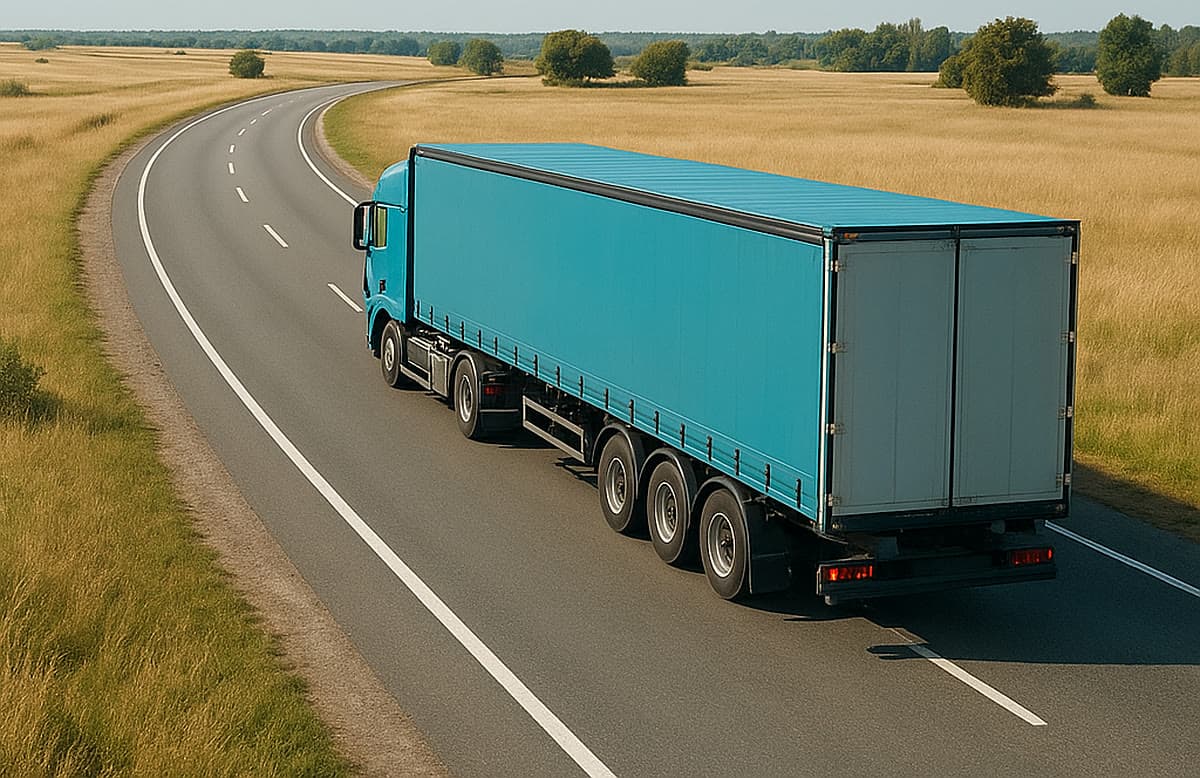
Truck coming back empty: what 500 km of deadhead mileage costs a carrier
An empty run is not a "free trip home"
For a Ukrainian road haulier, deadhead mileage means the truck, the driver and the fuel are all working without generating any revenue. The problem is felt most on return legs: the truck has delivered its load, but no backhaul could be found because of demand imbalances between regions, tight delivery deadlines or unfavourable waiting times.
Over a 500 km distance, costs pile up quickly. Even without counting the potential revenue lost on a load, the carrier pays for diesel, the driver's working time, depreciation of the tractor and semi-trailer, tyres, servicing and related operating expenses. That is why the question of how much a carrier loses on deadhead mileage should be answered with more than just the fuel receipt.
Estimated cost of 500 km
Below is a model calculation for a long-haul truck-trailer combination with actual consumption of 28–35 l of diesel per 100 km. The diesel price is taken at 95–100 UAH per litre: as of 17 September 2026, the average price in Ukraine was 98.24 UAH/l (fuel prices). The real amount depends on the vehicle model, its weight, terrain, traffic jams, driving style and route conditions.
| Cost item | Estimate for 500 km |
|---|---|
| Diesel fuel | 13,300–17,500 UAH |
| Driver wages and per diems | 3,000–5,000 UAH |
| Tyre wear, maintenance, repair reserve | 2,500–4,000 UAH |
| Insurance, dispatching, administrative costs | 1,000–2,000 UAH |
| Total direct costs | 19,800–28,500 UAH |
Losses can exceed direct costs
The figure of 20–29 thousand UAH is the approximate cost of an empty return, not the full financial impact. If a paying load could have been carried over those 500 km, the company also misses out on revenue. That is exactly why how much a carrier loses on deadhead mileage depends in each case on the rate the market was actually offering in the return direction.
- On a single trip, an empty return can "eat up" a significant share of the delivery margin.
- With regular empty runs, the cost of every contract goes up.
- Finding a backhaul, even at a lower rate, is sometimes more profitable than driving without a load.
The practical takeaway: before setting off, compare the cost of waiting for a load, a possible discount on the return trip and the cost of running empty. For a carrier, 500 km without cargo is not just a logistical inconvenience but a measurable operating loss.
What 500 km without cargo actually costs
Baseline assumptions for the calculation
To understand how much a carrier loses on 500 km of deadhead mileage, it is not enough to multiply fuel consumption by the price of diesel. An empty truck-trailer may indeed burn slightly less fuel than a loaded one, but the tractor, the semi-trailer and the driver still work a full logistics shift.
For an indicative model, let's take a long-haul tractor with a semi-trailer, average consumption of 29–33 l per 100 km when empty, and a diesel price of 98 UAH/l. The trip is treated as a domestic run within Ukraine, with no border queues and no long downtime. On an international route the total can rise considerably due to toll roads, vignettes, ferries or additional charges.
An empty kilometre wears out the vehicle just as much as a loaded one, but brings in no income.
What 500 km costs: a breakdown by item
| Cost item | Assumption | Amount for 500 km |
|---|---|---|
| Fuel | 145–165 l × 98 UAH | 14,210–16,170 UAH |
| Driver wages | Shift, per diems and payroll charges | 3,000–4,500 UAH |
| Depreciation, maintenance and repair reserve | Wear of tractor, trailer, tyres, lubricants | 2,500–4,000 UAH |
| Insurance and dispatching | Share of the trip's fixed costs | 700–1,500 UAH |
| Toll roads and related charges | 0 UAH on a typical domestic run; more abroad | 0–3,000 UAH |
| Total | Excluding lost revenue | 20,410–29,170 UAH |
This is not a universal rate but a working benchmark for planning. Newer, more fuel-efficient vehicles, cheaper contract fuel or a shorter driver shift will bring the total down. At the same time, traffic jams, detours, winter conditions and repairs en route can quickly push it up.
Costs that are often overlooked
The most common mistake is to count diesel only. Yet to answer the question of how much a carrier loses on deadhead mileage, you need to add indirect costs and the cost of lost time: at that moment the truck cannot carry out another order.
- downtime at loading or while waiting for an order;
- extra mileage to a filling station, service centre or parking area;
- freight exchange or dispatcher commission;
- margin missed on a potential backhaul.
Even a load at a lower rate can be more profitable than an empty return if it covers the trip's variable costs.
How much a carrier loses on deadhead mileage: a sample calculation for a truck
How to calculate losses from an empty return correctly
The answer to the question how much a carrier loses on deadhead mileage has two parts. The first is the direct costs the company actually incurs while driving without a load: diesel, the driver's salary, vehicle wear, tyres, maintenance and overhead payments. The second is revenue foregone — what the truck could have earned had a load been found for the return journey.
It is important not to confuse revenue with profit. The rate per kilometre is the money that would potentially have come from the customer; part of that amount would have gone on performing the trip anyway. For fleet planning, however, an empty 500 km means both unavoidable costs and a lost opportunity to earn.
Three scenarios for a 500 km distance
The table shows model calculations for a tractor with a semi-trailer. In addition to fuel, direct costs include driver wages, depreciation, repair reserve, insurance and dispatching. The return-direction rate is taken slightly lower than for the outbound trip: on long routes in SAMO-TRANS listings in September 2026 it held at around ≈60–80 UAH/km, and carriers often take backhauls for less. Specific figures depend on the route, vehicle class, fuel contract terms and demand for cargo.
| Scenario | Consumption and diesel price | Direct costs for 500 km | Return-direction rate | Revenue foregone |
|---|---|---|---|---|
| Economical | 27 l/100 km × 95 UAH/l | ≈19,800 UAH | 50 UAH/km | 25,000 UAH |
| Average | 31 l/100 km × 98 UAH/l | ≈22,700 UAH | 60 UAH/km | 30,000 UAH |
| High-cost | 35 l/100 km × 102 UAH/l | ≈26,400 UAH | 70 UAH/km | 35,000 UAH |
What this example shows
In the average scenario, an empty return costs about 22.7 thousand UAH in real operating expenses. At the same time, the carrier misses out on roughly 30 thousand UAH of potential revenue. So how much a carrier loses on deadhead mileage, in a broad management sense, amounts to up to 52.7 thousand UAH of combined negative impact: costs plus unused capacity.
This sum should not be mechanically booked as an accounting loss for a single trip, since revenue foregone does not equal net profit. But it clearly shows the price of the decision to drive without a load and explains why carriers are often willing to take a backhaul at a lower but economically justified rate.
Why empty runs are getting more expensive for Ukrainian carriers
Cargo moves unevenly — and so do trucks
The main cause of empty runs is imbalanced freight flows. In one direction, a region or country may actively take in building materials, food, industrial goods or humanitarian cargo, yet lack enough goods to ship back. As a result, the tractor delivers a paying load, but a return load has to be waited for, sought far from the unloading point, or cannot be found at all.
On the Ukrainian market this is especially noticeable on routes between major logistics hubs, border regions and regions with different industrial specialisations. For example, demand for trucks to deliver imported goods to inland regions does not always mean the same volume of exports or domestic shipments in the opposite direction.
Borders, seasonality and routes raise the cost of waiting
In international transport, empty running often begins before the truck even leaves the country. Border queues, changes in checkpoint operating hours, document checks and unpredictable clearance times make planning harder. A customer may refuse to wait for a truck with an uncertain arrival time, and the carrier may lose an available backhaul.
Seasonality and route restrictions also play a role. During harvest, pre-holiday consumer demand or active exports, the number of orders and rates can change within days. Meanwhile, road repairs, detours, war-related risks, traffic restrictions and the need to adjust logistics add mileage to the loading point.
- the truck spends time looking for an order after unloading;
- the available cargo may not match the semi-trailer type or payload capacity;
- a remote loading point adds unpaid kilometres;
- the return-direction rate may be below cost.
Competition forces a choice between a cheap load and an empty run
When there are more trucks than orders on a given lane, competition for jobs intensifies. Carriers cut prices to avoid returning empty, but a rate that is too low may cover only part of the costs. This is where it becomes clear how much a carrier loses on deadhead mileage: an empty run locks in the entire loss at once, while a cheap backhaul at least reduces the cost of fuel, the driver and vehicle wear.
The best decision depends on the specific economics of the trip. The carrier needs to compare not only the rate on offer, but also the distance to the loading point, waiting time, the risk of downtime and the likelihood of finding a better-paying load later.
How to reduce losses from deadhead mileage
Look for a load before you unload
The most effective way to cut empty running is to plan the return trip alongside the outbound one, not after delivery. The dispatcher or fleet owner should know the date, the unloading city, the semi-trailer type, the available payload and the acceptable waiting time. This makes it easier to find a full backhaul or a part load in advance. An example from real listings is the round trip Bakhmach — Volochysk — Kamianets-Podilskyi — Bakhmach, where a repositioning run of just 125 km almost doubles revenue per kilometre driven: the calculation is in the article on Ukraine's highest-paying freight routes in September.
To do this, carriers use freight exchanges — for example, cargo search on SAMO-TRANS — as well as their own customer base, direct requests to forwarders and professional carrier communities. A part load will not always fully offset the cost of 500 km, but it can cover the diesel or the driver's pay. Consolidation is especially useful for trucks with partly free space after delivery: several small shipments can sometimes add up to an economically viable trip.
Not every backhaul is worth taking
Reducing deadhead mileage does not mean agreeing to any rate. Before confirming an order, calculate the extra kilometres to the loading point, downtime, fuel consumption, the risk of delayed payment and whether the cargo is compatible with the vehicle. If a truck drives 80 km empty for a cheap 200 km load, the job may turn out to be loss-making.
- set a minimum rate that covers the trip's variable costs;
- charge separately for vehicle positioning and deviations from the main route;
- offer customers a discount for flexible loading dates;
- combine regular contracts in opposite directions;
- set an acceptable waiting time after unloading.
Flexible pricing lets you sell return capacity for less than the outbound trip, but not below the level at which the journey increases the loss. This very approach directly affects how much a carrier loses on deadhead mileage.
Routes, partnerships and telematics turn data into savings
Partnering with other carriers and forwarders helps exchange orders on "awkward" lanes. One carrier may have regular shipments to a region, while another has steady cargo going back. Joint planning reduces empty kilometres without the need to maintain a large in-house sales department.
Telematics and TMS systems provide the real picture: where the vehicle runs empty, how much fuel it uses, how long it stands idle and which lanes have the lowest margin. Comparing planned and actual routes helps identify unnecessary detours, poorly coordinated positioning and systematic empty returns. If deadhead mileage regularly exceeds the planned level, the problem should be solved not by a one-off search for a load but by reviewing the route network and contract terms.
What this means for you: how empty mileage affects the delivery rate
Why an empty return affects the delivery price
For a shipper, the transport rate is not just payment for the kilometres from the sender's warehouse to the unloading point. The carrier assesses the vehicle's entire work cycle: positioning for loading, the main route, possible downtime and the likelihood of returning empty. If a lane consistently lacks return orders, the risk of deadhead mileage is partly built into the price of the "one-way" trip.
That is why the same distance can carry different rates depending on the region, the season and the cargo balance. Deliveries in a direction where a backhaul is easy to find usually have better economics. On difficult lanes, the answer to how much a carrier loses on deadhead mileage directly shapes the commercial offer.
Who actually pays for empty kilometres
The road haulier feels the costs first: it pays for diesel, the driver, repairs and vehicle wear with no revenue for the return leg. But when the imbalance persists, the carrier cannot keep absorbing this loss out of its own margin. Part of the costs passes into the shipper's rate, then into the cost of production, and in some cases into the final price of goods for the buyer.
For the driver, the problem shows up as longer shifts, waiting for orders and an unstable schedule. At the same time, the search for a backhaul must not lead to breaches of working and rest time rules or dangerous haste on the road. Savings on empty mileage should come from planning, not from overloading the crew.
What to ask a carrier before agreeing on a rate
Open dialogue helps the shipper understand what they are paying for and helps the carrier offer a realistic price with no hidden risks. This is especially important for irregular routes, urgent shipments and deliveries to regions with a limited number of return loads.
- whether the rate includes vehicle positioning and empty mileage to the loading point;
- which route and mileage were used in the calculation;
- whether waiting, loading, unloading and possible downtime are included;
- which surcharges apply if the address, positioning time or cargo weight changes;
- whether a flexible loading window is possible so the carrier can find a return trip.
For the reader, the practical takeaway is simple: a lower rate does not always mean a better deal on delivery. If it does not cover the real logistics, the risks grow of missed deadlines, attempts to renegotiate the price or a drop in service quality. Understanding how much a carrier loses on deadhead mileage helps you assess a rate realistically.
FAQ: deadhead mileage in freight transport
What counts as deadhead mileage, and what level is normal?
Deadhead mileage is the kilometres a truck covers without commercial cargo. It includes not only the empty return after unloading, but also positioning the vehicle for loading, moving to another customer, and driving to a parking area, service centre or border crossing. For the carrier these are full costs for fuel, the driver and the vehicle, but with no direct revenue.
There is no single "normal" percentage for all transport. It depends on the lane, body type, seasonality, how regular the contracts are and the balance of freight flows. For a fleet it is more important to track its own trend: if the share of empty kilometres grows for several months in a row, that is a signal to review routes, the customer base or the rules for accepting orders.
Is a carrier entitled to include empty mileage in the rate?
Yes, a carrier may factor the risk or actual cost of empty running into the commercial rate, provided the price is agreed with the customer. Most often it is not listed as a separate line: the costs are already included in the "point A to point B" delivery price. For non-standard positioning, remote loading or a route change, empty kilometres may be charged as a separate surcharge.
The shipper should state in the order exactly what the rate includes: vehicle positioning, waiting, loading, unloading, toll roads, additional addresses and acceptable downtime. This reduces the risk of misunderstandings after the trip is completed.
How can you check whether the quoted price is justified?
Ask the carrier to explain the planned route, total mileage, vehicle type and key surcharges. It is useful to compare several offers, but only on identical terms: cargo weight and dimensions, positioning deadlines, temperature requirements, insurance and payment terms. The cheapest rate may not include costs that will later appear as separate invoices.
The question of how much a carrier loses on deadhead mileage does not require a company to disclose all of its internal economics. Still, a clear explanation of why a lane carries a higher rate is a sign of a transparent approach. If the price is significantly lower than market alternatives, it is worth checking whether it hides unrealistic deadlines, undisclosed restrictions or a risk of the rate being revised mid-transport.
Conclusion
A truck returning empty over 500 km is not a minor inconvenience but a significant cost item. According to model calculations, direct costs for diesel, the driver's work, depreciation, tyres, maintenance and overhead payments can amount to roughly 20–29 thousand UAH. The exact figure varies with fuel consumption, diesel price, vehicle type, downtime, route and transport conditions.
At the same time, direct costs do not show the whole picture. If a load was available for the 500 km back, the carrier also misses out on potential revenue. That is why how much a carrier loses on deadhead mileage should be assessed in two dimensions: as real money spent with no income, and as the vehicle's lost commercial capacity. In the average scenario, this can mean about 22.7 thousand UAH of operating costs plus roughly 30 thousand UAH of revenue not earned.
For the shipper, this factor explains why the rate for the same distance varies by direction. If it is hard for the carrier to find a load back, the risk of empty running ends up in the price of the main delivery. For the driver, it means more waiting and a less stable schedule, and for the end buyer, a share of logistics costs in the price of goods.
The key practical takeaway: look for a return load before the main cargo is unloaded. Freight exchanges, part loads, partnerships between carriers, flexible time windows and route monitoring via telematics help reduce the share of unpaid kilometres. Even a return trip at a lower rate can be justified if it covers variable costs and creates no additional risks. You can calculate the economics of your own trip, including fuel, the driver and empty mileage, in the trip profitability calculator.

Related posts



Do you have cargo or transport?
Post your offer — and find the right partner today.