Where carriers earn more: Ukraine's 10 highest-paying freight routes in September 2026
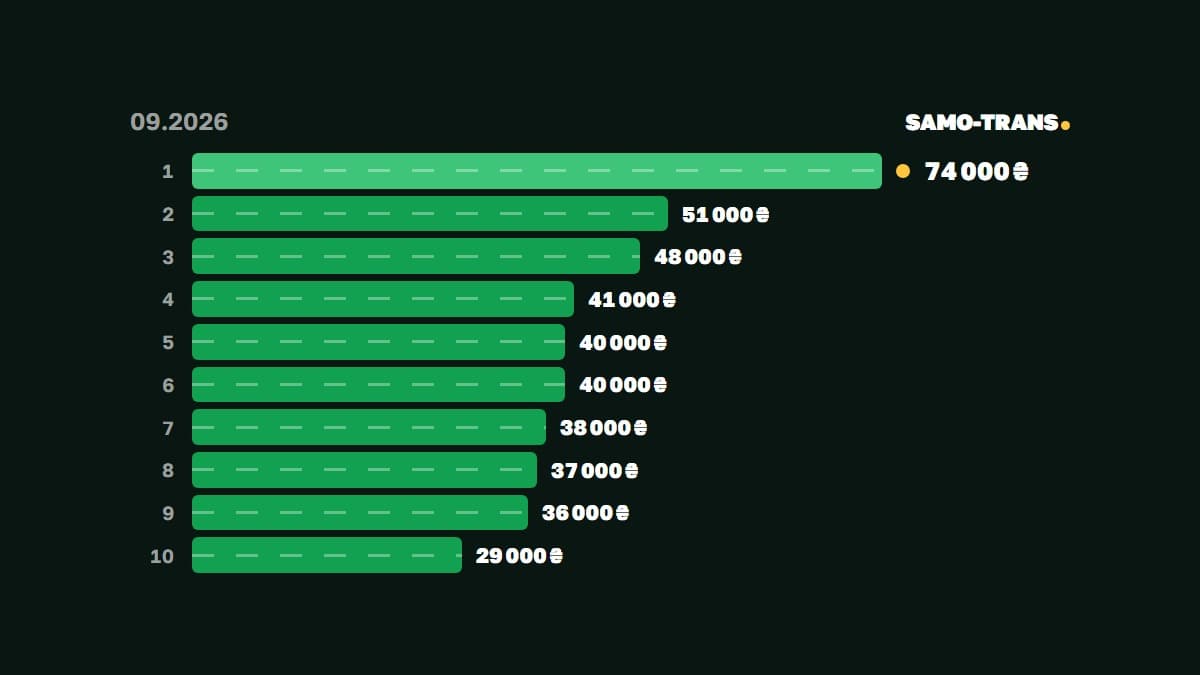
Where carriers earn more — the most honest answer to that question comes not from price lists but from the listings shippers are publishing right now. We analysed public cargo listings on SAMO-TRANS from 18 August to 17 September 2026 and ranked the domestic routes where shippers offered the most for a full truckload.
How we built the ranking
Only listings that can be fairly compared with each other made it into the sample:
- domestic trips within Ukraine, no international transport;
- full truckload — from 18 tonnes;
- a fixed rate per trip in UAH, not "price on request" or a per-tonne tariff;
- a distance of 200 km or more, so that short urban deliveries don't distort the picture.
Each row of the ranking is a real listing or several similar listings on the same lane. It is the rate offered by the shipper, not the final amount after negotiation. Some rates are quoted incl. VAT — this is marked in the table, since a 20% tax significantly changes the comparison. Distance is the approximate road distance between the towns.
Top 10 highest-paying freight routes: the September ranking
| No. | Route | Cargo | Rate per trip | Distance | Per 1 km |
|---|---|---|---|---|---|
| 1 | Kropyvnytskyi — Runkoshiv (Khmelnytskyi region) | mineral fertilisers, 23 t | 74,000 UAH incl. VAT | ≈485 km | ≈153 UAH |
| 2 | Bakhmach — Ivano-Frankivsk region | mineral fertilisers, 23 t | 51,000 UAH incl. VAT | ≈700 km | ≈73 UAH |
| 3 | Dnipro — Zhytomyr | scrap metal, 25 t, tipper | 48,000 UAH | ≈620 km | ≈77 UAH |
| 4 | Brovary — Illintsi | manufactured goods, 21 t | 41,000 UAH | ≈245 km | ≈167 UAH |
| 5 | Sloviansk — Oleksandriia | building materials, 22 t | 40,000 UAH | ≈465 km | ≈86 UAH |
| 6 | Kamianets-Podilskyi — Bakhmach | mineral fertilisers, 23 t | 40,000 UAH incl. VAT | ≈660 km | ≈60 UAH |
| 7 | Bakhmach — Volochysk | mineral fertilisers, 23 t | 38,000 UAH incl. VAT | ≈640 km | ≈59 UAH |
| 8 | Dnipro — Kyiv region (Kniazhychi, Pereiaslav, Bila Tserkva) | various cargo, 22–22.5 t | 33,000–37,000 UAH | ≈420–560 km | ≈64–79 UAH |
| 9 | Kryvyi Rih — Sumy | metal wire, 22 t | 36,000 UAH incl. VAT | ≈460 km | ≈78 UAH |
| 10 | Mala Divytsia — Znamianka | mineral fertilisers, 23 t | 29,000 UAH incl. VAT | ≈305 km | ≈95 UAH |
Three things stand out straight away. First, five of the ten routes carry mineral fertilisers in big bags. Second, long 600–700 km trips bring the biggest total but one of the lowest rates per kilometre. Third, the per-kilometre record belongs not to the longest trip but to the short Brovary — Illintsi run.
Why these particular lanes pay more
Fertiliser season
September is when farms get ready to sow winter crops. Mineral fertilisers are hauled from plants and warehouses to farms, and the deadlines are tight: sowing won't wait until a cheaper truck turns up. That is why fertiliser shippers offer high rates and work with VAT. One-tonne big bags are easy to load from the side, so a standard curtainsider will do, and often a grain truck too.
The destination is a village, not a regional centre
Runkoshiv is a village in Kamianets-Podilskyi district, not far from the Dniester. It is almost impossible to pick up a return load there straight away, so the carrier builds the trip back into the rate. Hence ≈153 UAH/km at the top of the ranking: even excl. VAT it comes to about 127 UAH/km. For more on what an empty return costs, see the article "The truck comes back empty".
Risk and specialised vehicles
Sloviansk is in the frontline Donetsk region. Fewer carriers are willing to go there and the risks are higher, so even building materials travel at ≈86 UAH/km. The Dnipro — Zhytomyr trip needs a tipper for scrap metal, and not every carrier has one: tighter supply means a higher rate.
A short trip with several stops
Brovary — Illintsi is a 245 km warehouse-to-warehouse haul for 41,000 UAH, i.e. ≈167 UAH/km. Including loading and unloading, a trip like this takes a full working day. The shipper is effectively paying for a day of the truck's work, not just for the kilometres.
Where carriers earn the most: per trip, per kilometre or per day
The same ranking looks different depending on what you count:
- by trip total, long 600–700 km routes lead, but they usually take two working days;
- per kilometre, 250–350 km trips pay better — 95–167 UAH/km;
- per day of truck work, 41,000 UAH for one day on the Brovary — Illintsi trip beats 51,000 UAH for two days on the Bakhmach — Ivano-Frankivsk region trip.
Don't forget about fuel. As of 17 September 2026, the average diesel price in Ukraine is 98.24 UAH/l (see fuel prices). At a consumption of 32 l per 100 km, fuel alone costs ≈31 UAH for every kilometre. So out of a 59–60 UAH/km rate, less than half is left for the driver, depreciation, taxes and profit — and only if the truck doesn't come back empty. You can check the economics of a specific trip in the trip profitability calculator.
A round trip instead of an empty return
Within a single week, SAMO-TRANS had listings in both directions: Bakhmach — Volochysk for 38,000 UAH and Kamianets-Podilskyi — Bakhmach for 40,000 UAH (both incl. VAT). Volochysk and Kamianets-Podilskyi are only ≈125 km apart. Compare the two options:
| Option | Mileage | Revenue | Per 1 km driven |
|---|---|---|---|
| Bakhmach — Volochysk and back empty | ≈1,280 km | 38,000 UAH | ≈30 UAH |
| Bakhmach — Volochysk, 125 km repositioning, Kamianets-Podilskyi — Bakhmach | ≈1,430 km | 78,000 UAH | ≈55 UAH |
The rate per kilometre driven almost doubles. That is exactly why experienced dispatchers look for a backhaul before the truck has even unloaded.
What this means for shippers
- Compare rates on the same basis. 74,000 UAH incl. VAT is ≈61,700 UAH excl. VAT. Mixing the two formats is the easiest way to get your budget wrong.
- A remote destination and urgency cost money. If you are delivering to a village with no return loads, budget for a premium or give the carrier a flexible loading window.
- A rate that is too low on a long trip is a risk. When fuel eats up ≈31 UAH/km, an offer of 45–50 UAH/km for 600+ km often means the truck won't show up or the carrier will try to renegotiate the price.
- State the price in your listing. A specific rate lets the carrier work out the trip right away and respond, instead of spending a day on clarifications.
Frequently asked questions
Are these rates market tariffs?
No. These are the rates of specific listings published on SAMO-TRANS over the past month. They show how much shippers are willing to pay on these lanes right now, but they don't guarantee the price for your cargo: that will depend on the date, body type, loading conditions and payment terms. Indicative rates on popular routes are collected in the article "How much does a truck cost across Ukraine in September 2026".
Why is the per-kilometre rate higher on a short trip?
Because the truck spends as much time on loading, unloading and waiting as it does on a long trip, but covers fewer kilometres. The carrier prices a working day, so on 250 km the per-kilometre rate is inevitably higher than on 700 km.
How do I compare a rate incl. VAT with a rate excl. VAT?
Divide the rate incl. VAT by 1.2 — you get the amount before tax. For example, 51,000 UAH incl. VAT corresponds to ≈42,500 UAH excl. VAT. Before agreeing, check which format the carrier will invoice in.
Where can I find listings like these?
In the cargo search on SAMO-TRANS. Listings can be filtered by loading and unloading region, body type and date — which makes it easier to plan both the outbound and the return trip.
Conclusion
In September 2026, the highest full-truckload rates on SAMO-TRANS were offered by mineral fertiliser shippers, as well as by shippers from remote villages, frontline areas and short warehouse-to-warehouse runs. By trip total, 600–700 km trips lead; per kilometre, 250–350 km routes come out on top.
For carriers the takeaway is simple: count not only the rate but also the days on the road, fuel at 98 UAH/l and the chance of a return load. The most profitable trip is the one after which the truck doesn't come back empty. For shippers: compare rates in the same format and don't lowball prices on long lanes — in fertiliser season, trucks go where the pay is realistic.

Related posts

Do you have cargo or transport?
Post your offer — and find the right partner today.